Reiki is an ancient form of hands-on healing that was brought to the West from Japan in the early part of the twentieth century. The “father of modern Reiki” was Dr. Mikao Usui, and the most traditional form of Reiki today is called Usui Reiki. The history of Reiki is readily available online and is both interesting and controversial.
Pronounced “ray-key”, Reiki is a form of energy bodywork that reduces stress, induces relaxation, and promotes healing. It does this by allowing the client to tap into an unlimited supply of “ki” or “qi”, which the Chinese pronounce as “chi”. Our unseen life force energy or our “ki/qi” is what causes us to be alive.
In fact, the word, Reiki, itself means “universal life energy”, and Reiki is administered by “laying-on hands”. It is a simple and powerful technique that can be learned by anyone. It is passed from teacher to student by attunement, and it is passed from practitioner to client by laying on of hands.
Until the advent of quantum physics, no one really understood how energy workers were able to get results. Some even feared the use of supernatural forces. However, Reiki and other similar kinds of energy work like Polarity, Huna, Healing Touch, and Qigong Healing use the fields of energy that physicists have proven surround each molecule of matter. In a living being, these fields are called biofields.
The biofield is both wave and particle, like light itself, and it has many of the properties of light. It also has electromagnetic properties. It is a part of the Zero-Point Field, which is a substructure of energetic frequency that underpins the entire universe.
The Zero-Point Field also functions as a recording medium of everything, providing a means for everything to communicate with everything else. When you consider that on a subatomic level, cells and DNA also communicate through frequencies unrelated to the physical nervous system and that they also communicate directly with the Zero-Point Field, you have the basis for how Reiki works.
Indeed, researchers have shown that the human biofield communicates with all parts of the body faster than the neural network is able and that biofields of living things communicate with each other. So if your plants grow because you talk to them, or your dog knows when your car turns onto your street, it may be that your biofields are communicating!
We literally pick up frequencies in our environment, and this has been proven in the laboratory. We all have anecdotes of walking into a room and getting a bad “vibe”. That is our biofield resonating with our environment, and it’s a survival instinct which is often observed in animals who will balk at running toward an unseen danger. When we are physically ill or in pain, the biofield picks this up also. We might think of this a disharmony in the resonance pattern.
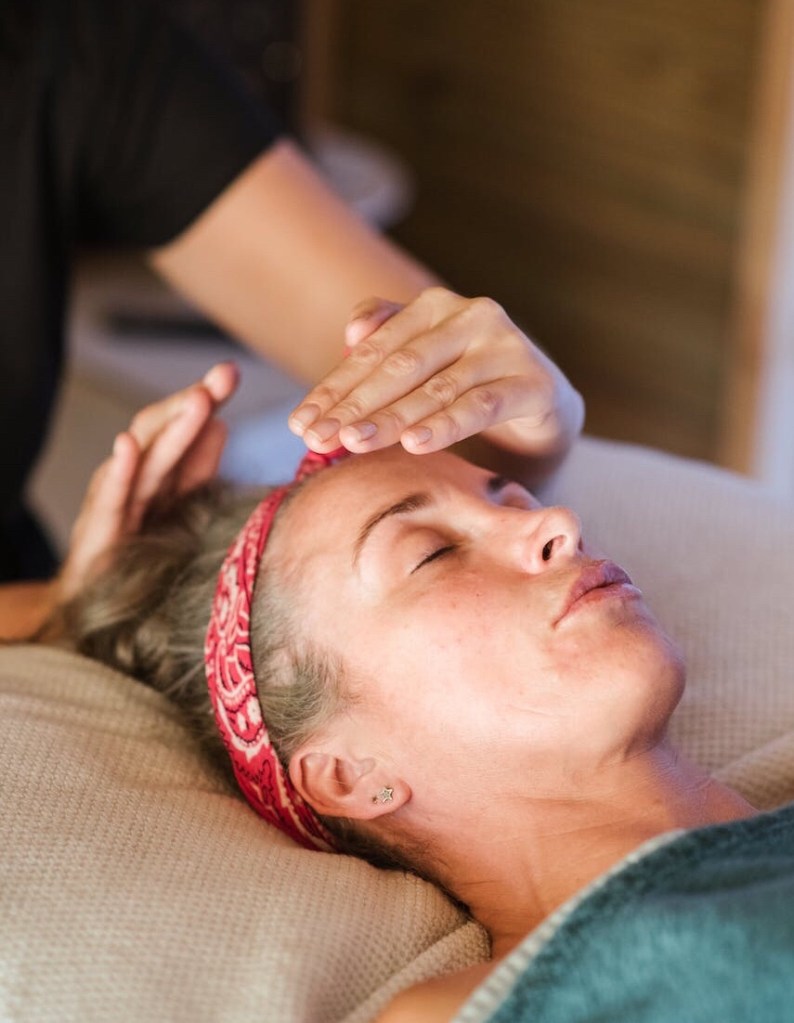
Clint receiving Reiki energy treatment
What Reiki seems to do is allow the biofield to resonate with the healing properties of the Reiki energy or ki/qi itself and to rebalance. This is called coherence. A Reiki session can bring disturbed energies in our bodies to a more harmonic state. Because our bodies strive for homeostasis, Reiki can facilitate the body’s self-healing capabilities.
According to a 2009 article National Center for Complementary and Alternative Medicine (NCCAM), “People use Reiki for relaxation, stress reduction, and symptom relief, in efforts to improve overall health and well-being. Reiki has been used by people with anxiety, chronic pain, HIV/AIDS, and other health conditions, as well as by people recovering from surgery or experiencing side effects from cancer treatments. Reiki has also been given to people who are dying (and to their families and caregivers) to help impart a sense of peace. Clients may experience a deep state of relaxation during a Reiki session. They might also feel warm, tingly, sleepy, or refreshed. Reiki appears to be generally safe, and no serious side effects have been reported.”
Researchers Susan Thrane and Susan Cohan, both at the University of Pennsylvania School of Nursing, searched forty-seven research articles to discover if Reiki had a measurable effect on pain and/or anxiety in cancer and post-surgery patients as well as seniors living in a dedicated setting. To conform to their criteria for control groups and size of study, this number was whittled down to seven studies at which they looked in depth. In all, Reiki showed evident of decreasing pain or anxiety levels over the placebo (sham Reiki) or rest alone.
Thrane and Cohan’s article, republished by The National Library of Medicine, contains excellent diagrams showing how quantum physics is being used to explain the effectiveness of Reiki and other energy modalities. They point out the similarities between device-generated electromagnetic field for wellness such as a TENs unit and human-generated biofield energy such as Reiki. They conclude that more research is needed.
Reiki is easy to integrate with massage or other modalities like Craniosacral Therapy. You can have Reiki alone and usually will be fully clothed if that is the case. It’s a great modality for someone who is a little modest about massage, and Reiki alone has many of the same benefits as massage. It’s also good for the very ill or for fibromyalgia patients for whom massage that directly manipulates the tissues would be painful or otherwise contraindicated.
Much of the early literature written about Reiki was not based on science. We are gratified that anecdotal evidence of Reki’s effectiveness is now being corroborated by controlled scientific studies in quantum physics.
I recently took a new Craniosacral Therapy class from the Upledger Institute on unwinding the meridians. We studied the rudiments of Traditional Chinese Medicine in massage school, and there was a good bit of TCM on the NC Board of Massage and Bodywork Therapy licensing exam, which I took in 2007. (Wow! Have I been doing massage that long?)
We also took Touch for Health Level 1 in massage school as the owner of the now closed Whole You School of Massage and Bodywork, Cheryl Shew, believed it was one of the best classes to prepare us for the massage exam. It is based on TCM and applied kinesiology and is an incredibly effective method for balancing meridians and toning muscles.
After I finished massage school, I took the Levels, 2, 3, and 4 Touch for Health classes, and my teachers, Larry and Arlene Green, offer refreshers and online “get together” frequently. When I began the Unwinding Meridians class, I suspected my TFH books and charts might come in handy, I was right. Much of the material I had previously learned was applicable to the new technique.
I realized I needed to brush up on things though, and it actually got me excited. The more something in the class triggered previous knowledge, the more confident I felt that this is a modality I can use.
So what is it that got me so pumped? Well first of all, I could actually feel the craniosacral rhythm/energy movement when I put my fingers on the acupuncture points. As with traditional craniosacral therapy, the touch is light and less like acupressure or Shiatsu massage.
Before I tried the work on a client, I made sure to look up the acupuncture points for a problem I know she has. I could feel the rhythm shifting and changing even more strongly, maybe because I was working on a real problem. She shared my excitement.
Using craniosacral therapy to unwind the meridians can help with the emotions as well. In Traditional Chinese Medicine, each meridian is associated with organs, emotions, seasons, colors, and a whole wealth of other correspondences. If a client has several points that need to unwind along the same meridian, you can sometime discover old trauma that is the source of chronic pain that seems to have no cause by asking questions related to the meridian correspondences. The inner physician knows and will often lead you to the truth you may be avoiding.
Unwinding the Meridians with Craniosacral Therapy is now a tool in my toolbox. I hope the more that I use it, the better I will get at help clients become pain-free and enjoy life more.
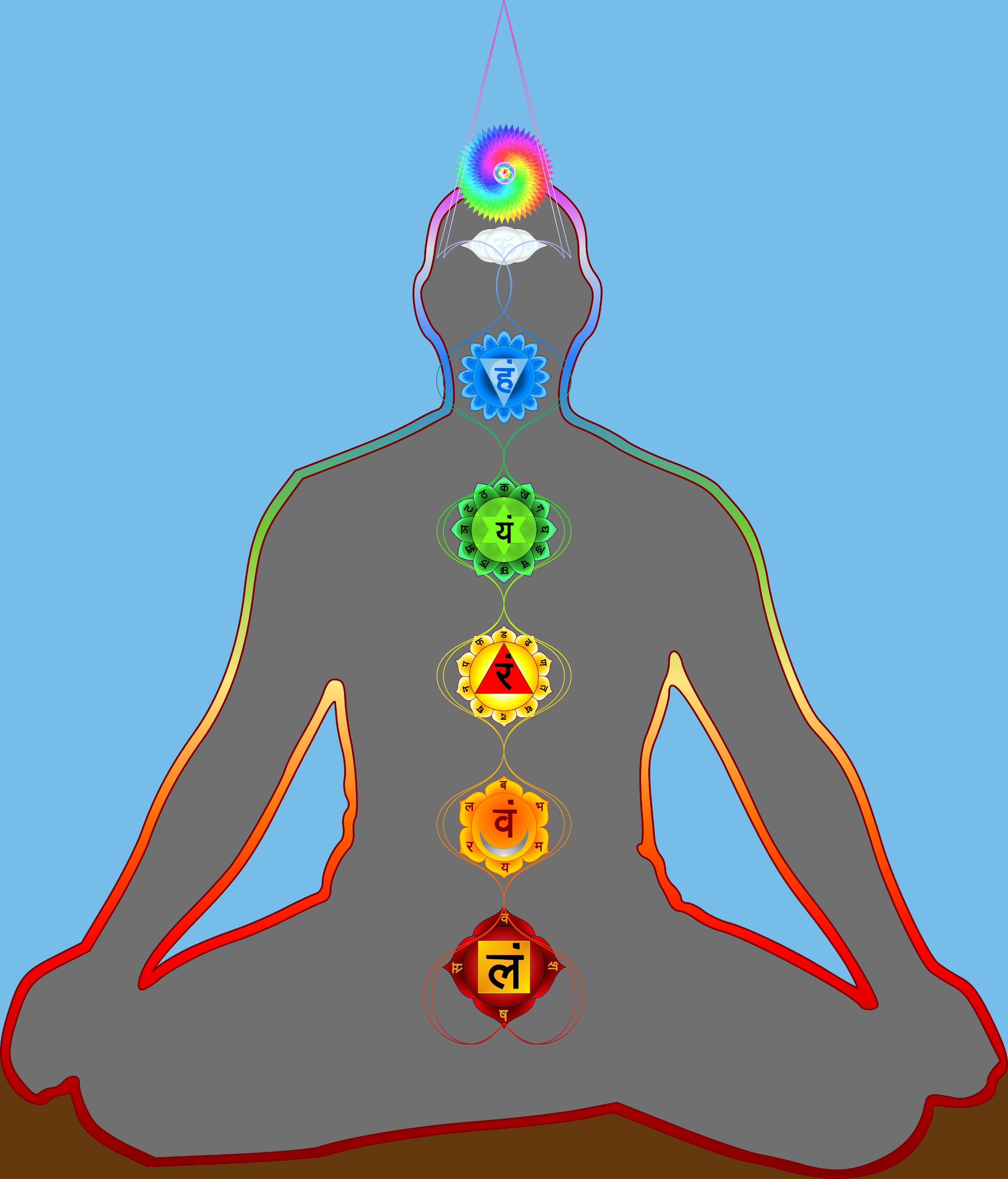
Aryuvedic tradition describes seven major energy centers that run along the spine and spiral out the front and back of the body in clockwise vortices. The Sanskrit word for these centers is chakra, meaning “wheel of light”.
From Wikimedia Commons. Modified from original by Mirzolot2.
Modern research in physics and biophysics suggests that these energy centers are also the sites of consciousness, which means consciousness is located throughout our bodies, not just in our brains. It also means that though most of us cannot see chakras, their health is vital to our humanity and our optimal growth.
Each of the seven major chakras corresponds to an electromagnetic field or “body” sometimes called the aura. Disruptions to the healthy functioning of the chakras can be detected in one or more layers of the auric field by trained energy workers and special machines that measure or photograph the electromagnetic charge and the photons emitted. They are probably picked up unconsciously by everyone. That is why some people calm us while others give off “bad vibes”.
Each of the seven major chakras seems to exert influence over specific physical, emotional, mental, and spiritual functions. For example, a disruption of the throat chakra might show up as thyroid problems, timidity, inability to express oneself clearly, and conflict between actions and religious convictions. (See forthcoming articles on each chakra for more information.)
Besides the seven major chakras, there are numerous secondary chakras throughout the body, most commonly located at the joints and nerve plexuses including the palms of the hands. Biophysicists across the world have shown that these secondary chakras may be responsible for a kind of cellular communication within our own bodies and between ourselves and others on an unconscious level. For example, mothers and children may literally communicate through light and other frequencies emitted from the secondary chakras so that a mother knows when her child is hurt or the child knows when the mother is gone. Dysfunction of the secondary chakras can cause delays in the healing process and/or a breakdown in the immune response.
One of the most respected teachers of chakra theory in the western world is Rosalyn L. Bruyere. She has been studied by such scientists as Dr. Valerie V. Hunt at UCLA in the famous Rolfing Study (Rolfing is a kind of massage), Dr. Fritz Albert Popp in a biophoton research study, Dr. Elmer Green in studies at the Menninger Clinic, and in a study on brain-damaged children at the Kennedy Krieger Institute of Johns Hopkins University, to name a few. Her web-site has links to many f these studies.
Bruyere is also the teacher of other respected energy healers. One of the most well-known of these is Barbara Brennan, who is renowned world-wide for her work with chakras as well.
According to Bruyere, aligning any one chakra helps to align the others, and while it is usual for energy workers to discuss chakras as being open or closed, it is more accurate to say that they are blocked or that the energy flow of a particular chakra is inhibited. Similarly, chakras can be over-excited, which also causes disease.
Bruyere also says that each chakra has a viewpoint or “prime directive”. When one of our chakras is over- or under-functioning, we have too much or too little of that chakra’s viewpoint in our lives. This will be discussed in more detail when we explore the function of each chakra.
“It has taken thousands of years, but within this century both scientists and spiritual seekers alike have once again begun to view the laws of nature and the laws of God as reflections of the same truth.” ~Rosalyn L. Bruyere
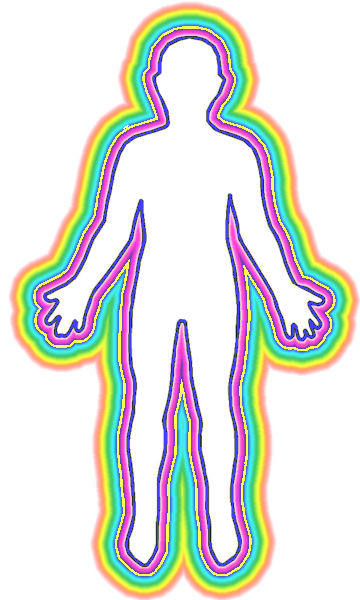
The aura surrounds the physical body in layers. Public domain image.
The auric field is has been measured by scientists as electromagnetic current that extends through and from the body for at least six feet, more or less, in the average healthy person. As each chakra spins, it creates its own electromagnetic field, which in turn combines with the other chakra fields to produce the aura. Each chakra ans the corresponding field have a particular frequency or vibration. With practice, you can feel the frequency of the field and of the chakra.
Bruyere’s book, Wheels of Light, includes a chapter in the appendix that gives the scientific research into verification of the aura. Barbara Brennan’s book, Hands of Light, gives one of the best descriptions of the correspondence between chakra and auric field. I am using Brennan’s descriptions of the aura here. She describes them as being in layers, with the etheric layer closest to the physical body.
However, it should be noted that other authors may disagree with Brennan because sensing the aura and the chakras is somewhat subjective to the energy worker him/herself despite the plethora of scientific research. That is one reason energy medicine is still having trouble achieving respectability among scientists who follow Newtonian rather than quantum physics. Likewise, the descriptions of the chakras and the aura are at least as old as the Hindu Upanishads. As with all ancient wisdom, understanding of the chakra system varies in interpretation from generation to generation as personal experience and now scientific verification adds to the body of knowledge.
The first chakra, called in Sanskrit the Muladhara, meaning wheel of the root/support. It is considered to be the seat of the physical body and is located the the base of the spine. It creates what Brennan calls the etheric body in the aura. It is equivalent to a blueprint for the physical body and is the densest and most easily sensed of the auric layers. Those who can see auras may describe it as looking like blue or gray vertical grid lines. It can be sensed in other living things as well though the color may vary according to the organism.
The second chakra in Sanskrit is called the Swadisthana or Svadisthana, meaning the abode of self. It is situated just behind and below the navel near the sacrum, and in Taoism and Traditional Chinese Medicine it is called the hara or tan tien. It creates what Brennan calls the emotional body. She describes it as being more fluid than the etheric body and varying in colors somewhat like many colored clouds. The colors change from brilliant to dull according to the emotional condition of the person. For example, clear feelings whether they be love or anger are brighter whereas confused feelings are darker and duller.
Manipura is the Sanskrit name for the third chakra. It means wheel of the jeweled city. Located on the spine near the solar plexus, it creates the mental body in Brennan’s description. Like the etheric layer, it is more structured and is mostly yellow in color. It, too, has a grid-like quality but not so pronounced as the etheric body. Brennan says it expands and becomes brighter when we concentrate or think deeply. It may also change color if we are engaged in habitual thought processes almost as if we are giving our thoughts literal form.
The fourth chakra is located near the heart and is called in Sanskrit Anahata, meaning wheel of the unstuck. It creates the astral body of the aura. Like the emotional body, it is composed of clouds of color, but Brennan says they are more beautiful and have a rose tint that indicates the influence of the chakra’s connection with love on the auric layer. Indeed, she says the layer becomes more rosy when we fall in love. Apparently, we connect with people through the energy of this auric layer, and the connection can be pleasant or not depending on the intentions that pass between us. Research done at the Heartmath Institute seems to confirm this assumption.
The fourth chakra marks a connecting point. While it is a common mistake to assume the lower chakras are somehow “less-than” the upper ones, the lower chakras are more concerned with incarnational, physical existence in the manifest world. The upper three chakras are typically described as influencing our spiritual nature. The heart chakra is the bridge that connects the mundane and the spiritual. However, one aspect is no less important than another. All parts of us make the whole, and blocks in any one chakra affect all of our being.
The fifth or throat chakra is on the cervical spine and is called in Sanskrit Vishuddha, meaning pure wheel. Brennan calls the firth layer the etheric template because it “contains all the form that exist on the physical plane in a blueprint or template form” (Brennan 52). She describes it as looking somewhat like a photographic negative though it does have cobalt blue grid lines just like the etheric layer that it supports and creates.
“The etheric template level of the aura creates an empty or negative space in which the first or etheric level of the aura can exist. The etheric template is the template for the etheric body, which then forms the grid structure … upon which the physical body grows.” ~Barbara Brennan
The sixth chakra is sometimes called the third eye or brow chakra because of its location at the top of the spine and in the midbrain. In Sanskrit it is called Ajna, which means command wheel. Brennan calls the body that corresponds to Ajna the celestial body. It is the emotional layer of the spiritual plane. It has pastel colors and an opalescent shine. It is associated with spiritual connection to God, the universe and all creation and is characterized by unconditional love. Just as the fifth layer helps support and create the first auric layer, the sixth layer supports and creates the second or emotional layer.
The seventh chakra is the Sahasrara in Sanskrit and means thousand-petaled wheel. It is located at the crown of the head. The crown chakra creates the ketheric template or the causal body. It is the mental level of the spiritual body and forms the outer, golden-silver egg-shape of the auric field. It is the strongest and most resilient level of the auric field. It is at this level that we know we are one with the creator.
Science has shown that disease often shows up in the aura before it shows up in the physical body. However, energy healing is not some esoteric or psychic ability that only a few gifted people are blessed to have. Naturally, there are some who more natural ability and others who have developed their abilities more than the rest of us, just like there are some athletes that can run faster than the rest of us. However, we all have the ability to use energy to heal, and we do so whether we realize it or not. We don’t have to see or sense auras to do it, either.
Every time a mother kisses a “boo-boo” to make it well or a friend holds the hand of sick loved-one, we share healing energy. Sometimes it sounds pretty woo-woo, but it is truly one of the most basic ways in which we relate and support one another. It is likely the way that Jesus healed, and he told us that what he could do, we could also.
Learning about the energy field can make us more sensitive to it, but we should all remember that any loving-kindness we show to each other and all loving thoughts have healing potential.
Bibliography
Brennan, Barbara. Hands of Light: a Guide to Healing through the Human Energy Field. New York: Bantam Books, 1988.
Bruyere, Rosalyn L. Wheels of Light: Chakras, Auras, and the Healing Energy of the Body. New York: Fireside Books, 1994.
Childre, Doc and Howard Martin. The HeartMath Solution: The Institute of HeartMath’s Revolutionary Program for Engaging the Power of the Heart’s Intelligence. New York: HarperCollins Publishers, Inc., 1999.
Dale, Cyndi. The Subtle Body: An Encyclopedia of Your Energetic Anatomy .Boulder, CO: Sounds True, Inc., 2009.
Ellis, Richard. Reiki and the Seven Chakras: Your Essential Guide. London: Vermillion, 2000.
Hunt, Valerie V. Infinite Mind: Science of the Human Vibrations of Consciousness. Malibu: Malibu Publishing, 1996.
Joy, W. Brugh. Joy’s Way.New York: Tarcher/Putnam, 1979.
McLaren, Karla. Your Aura and Your Chakras: The Owner’s Manual. York Beach, ME: Samuel Weiser, Inc., 1998.
McTaggart, Lynne. The Intention Experiment. New York: Free Press, 2007.
Myss, Caroline. Anatomy of Spirit: The Seven Stages of Power and Healing. New York: Harmony Books, 1997.
Schwartz, Gary E. The Energy Healing Experiments: Science Reveals Our Natural Power to Heal. New York: Atria Press, 2007.
Voigt, Anna. The Chakra Workbook: A Step-by-Step Guide to Realigning Your Body’s Vital Energies. San Diego: Thunder Bay Press, 2003.



 Tapestry Life's Blog