The skin is our largest sensory organ. Massage can create a sense of peace and well-being through the power of touch.
It is sometimes easy to emphasize the physical benefits of massage and forget the mental health benefits of regular bodywork. The physical benefits are more immediately recognizable, but the mental benefits can be more lasting.
Numerous clinical trials have evaluated the effects of massage on mental and emotional health, and the results are impressive. For example, studies indicate that massage and psychotherapy given to women suffering from postpartum depression had significantly greater improvement in both depression and anxiety than did groups who received only psychotherapy.
Similar results were found for individuals other than new mothers suffering from depression and anxiety. Other studies indicate that massage may help people who suffer from ADHD, Alzheimer’s disease, and bipolar disorder, to name a few.
Jacqueline Young, author of Complementary Medicine For Dummies, (London: Wiley Publishing, 2007) gives evidence for the efficacy of massage in treating those with eating disorders. She says more and more clinics treating anorexia and bulimia are finding that massage helps clients reduce anxiety about their appearance and improve their body image.
Massage reduces levels of stress hormones, especially cortisol (which, by the way, can make you fat!) It increases the activity of the parasympathetic nervous system (“rest and digest”) and decreases the activity of the sympathetic nervous system (“fight or flight”). Improved parasympathetic response means greater availability of brain chemicals like serotonin, oxytocin, and endorphins (natural painkillers).
Another benefit of massage is to meet our need for safe, human touch. Human beings can literally die without human touch, and studies have shown the devastating lack of emotional development in babies who are not adequately held and cuddled. Still, we live in a world where those who touch inappropriately have caused all of us to be a little suspect of too much touching. When there is a lack of touch in a person’s life, massage can fill the void and create peace-of-mind. Overall well-being is enhanced.
Massage provides the following mental health benefits:
Increases mental alertness and improves concentration and memory.
Reduces anxiety and increases sense of overall well-being and self-confidence.
Reduces stress hormone levels and increases production of mood-enhancing brain chemicals.
Provides an overall calming effect and lowers irritability.
Lowers brain wave activity to the alpha state, which provides a feeling of relaxation and increases creativity and organizational ability.
Calms the nervous system and improves synaptic response.
Relieves fatigue and renews energy levels.
There is also a relationship between mental health and physical ailments. Many of us carry stress in our bodies. Idioms like “he’s a pain in my neck” and “my job’s a headache” reflect physical responses to stress-causing people and situations. Massage can help relieve the stress before it manifests as a physical symptom.
I received an email this week from a new client who has been suffering from a headache lasting a week. I remembered reading a series in Massage and Bodywork Magazine, a publication of the Associated Massage and Bodywork Professionals (AMBP)), by Til Luchau. I pulled them out and reread them. Then I did a little more research online.
Luchau divides headaches into two broad categories: tension and musculoskeletal headaches in one category and migraine and other vascular headaches in the other. I’d add a third category: sinus headache. TMJ headaches might be a fourth category, and the general protocols for TMJ jaw pain often relieve the headaches as well. However, these headaches might be better categorized as a subset of TMJ dysfunction.
Luchau provides a chart for musculoskeletal/tension and migraine/vascular symptoms in his first article. My other research differs a bit on some points, but is in general consistent with Luchau. Understanding the symptoms is important because slightly different massage techniques are used for each type of headache. The image below offers a capsule version with hunger and eyestrain headaches omitted in the discussion that follows.
Common types of headaches
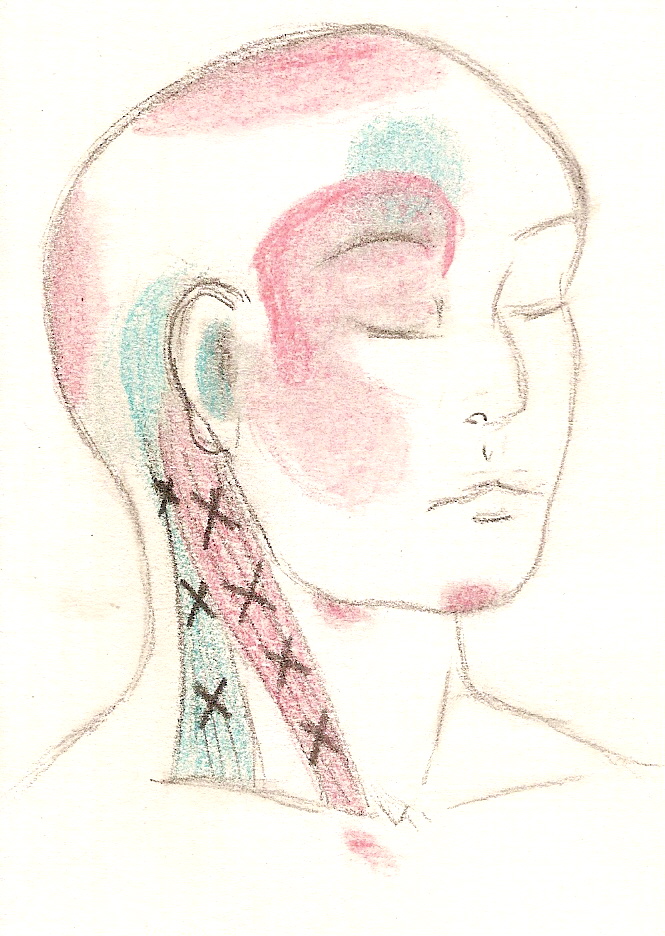
Tension headaches often arise when the muscles on the shoulders, back of the neck, under the occiput (posterior inferior cranium), and scalp become tight and pull on the scalp and the lining (dura mater) under the skull. Clenching the teeth is also a tension response and can cause headache even if TMJ dysfunction is not present.
Usually, tension headaches occur on both sides of the head, but if the musculature on one side of the body is tighter than the other, the pain may be worse on that side. It may also be worse in the back of the head, but depending on which muscles are hypertonic, it can be located almost anywhere. The pain is often a dull ache, but it may be more severe. It sometimes feels like squeezing or tightness in the head. Physical activity usually does not exacerbate it.
According to Luchau, the hands-on goal of working with tension headaches is to reduce the myofascial tension.
Sinus headaches are caused when the mucous membranes that line the four air-filled sinus cavities become irritated and swollen. The sinuses produce more mucus as a response, and the mucus that normally serves to moisten the air and soothe the sinuses becomes thicker and adds congestion that further blocks the sinus passages often creating a vacuum within them.
The pain is usually felt as pressure and/or tenderness just behind the eyes, cheeks, and forehead or near the upper teeth or temple regions. The pain may worsen if you lie down although lying down may reduce the pain of tension and migraine headaches. Bending over usually makes sinus headache worse. Your face may be noticeably swollen from a sinus headache.
If the cause of a sinus headache is infection, massage is contraindicated, and you should see a doctor immediately. Otherwise, massage with a hands-on goal of stimulating lymphatic drainage and relieving blocks caused by swelling and congestion may help.
Migraines are believed to be caused when the blood vessels inside the head dilate. Many migraine remedies include vasoconstrictors for this reason. However, according to Lachau, new research may point to another cause.
“Recent research suggests that migraines start as waves of nerve cell hyperactivity sweeping across the brain; the spreading waves in turn activate pain-signaling neurons in the brain stem. The root cause of these neuro-electrical ‘brain storms’ of abnormally increased activity is unknown. The hyperactivity is followed by inhibited nerve cell excitability; the cells seem to be worn out, and this exhaustion may explain difficulty speaking or thinking clearly after migraines” (Luchau, Sept./Oct. 2010).
The pounding or throbbing, sometimes stabbing, pain of a migraine is usually focused on one side of the head. It is frequently preceded by an “aura” or visual disturbance and is accompanied by nausea and sensitivity to light, sound, and odors. Physical activity can make it worse.
Most migraine sufferers have ideas about the triggers that cause their headaches and the symptoms that signal one is starting. They may also know that the massage protocols that work on tensions headaches often have little lasting effect on a migraine. Luchau’s hands-on goal of migraine massage is to reduce cranial compression, and I would agree that even if the migraine is initially triggered by muscular tension or sinus blockage, by the time it is a full-blown migraine, work on the cranium and the cranial fascia is necessary to relieve it.
Sometimes it is hard to tell what kind of headache it is. Generally, a look at the location and quality of the pain and at the response to activity and sensory input can help identify the type of headache you have. However, if you have a sudden, severe headache with no history of migraine headache or a dull headache that will not respond to treatment, you need to see your doctor immediately. Headaches can be a symptom of severe and even life-threatening conditions, stroke for example, and should not be ignored.
The massage protocol for a tension headache will include release of tight neck, shoulder and chest muscles and general relaxation strokes. Luchau’s first article emphasized release of the superficial and deep fascia of the scalp and a concentration of the suboccipital regions. I would add trigger point therapy of specific muscles likely to contribute to headache pain. Indeed, numerous research studies have cited the efficacy of massage, including specific pain-relieving modalities and more general relaxation type massage which tends to improve overall structural alignment and release endorphins into the body, as greatly relieving symptoms of tension headaches and even preventing headache recurrence when massage is received regularly.
Sinus massage with use of lymphatic drainage therapy is effective for relieving the pressure in the sinuses. (See my recent newsletter article on Sinus Massage.) The Lymph Drainage Therapy technique is slow and precise, and it uses feather-light strokes to move the lymph out of the head and into the nodes. It may also include the use of aromatherapy to further open the sinus passages.
Migraine headaches respond well to Craniosacral Therapy, especially intraoral work. CST allows the therapist to decompress the bones of the cranium and balance the blood flow. It also allows for structural realignment. Luchau’s technique uses a little more pressure than CST, but it is similar. (Trigger point therapy is often not as effective on migraines and on tension headaches.)
According to Luchau, the effect of this cranial work may be to reduce the pressure on the trigeminal nerve or to affect the hypothalamus and pituitary glands which may be responsible for the “brainstorm” of nerve cell hyperactivity mentioned in the quote above (Luchau, Nov./Dec. 2010).
Regular massage may also increase serotonin levels in migraine sufferers and thus prevent recurrence. Serotonin is a neurotransmitter and low serotonin levels have been indicated in migraine sufferers. Low serotonin also causes depression, seasonal affective disorder, addictions and eating disorders.
Two other modalities that seem to reduce headache pain are Myofascial Release and Reiki. Myofascial Release used gentle, light traction and stretching to release the fascia, which is a single sheath of connective tissue that covers the muscles, bones, organs, and even the cells (everything!) inside your body. Craniosacral therapy and lymph drainage therapy always incorporate myofascial release as do other modalities, but it can be used as a “stand-alone” modality. Reiki is one of a number of energy modalities that can be used to work on the subtle energy body. In many cases, this gentle therapy alone can relieve the headache.
Massage has been proven in study after study to decrease the severity and frequency of headaches. When you see your therapist, be sure to tell her the following to help her determine the best therapy protocol for your specific needs:
Where your pain is located
How long you’ve had the pain and if it comes and goes
How often you have headaches in general
If you’ve seen a physician and if so, what is the diagnosis
What precipitated the headache if you know
What is the quality of the pain (dull, throbbing, stabbing)
How movement and sensory stimulus affect the pain levels
What you have done to relieve it, such as taking pain relievers or using cold compresses, before coming to her
Headaches do not have to be a fact of life. Self-care and regular massage can be of great help in preventing them and relieving them when they do occur.
Foot care is especially important for the diabetic. Have your therapist look for cracks and ulcerations and be aware of too deep pressure you might not feel. Image by HealingDream at FreeDigitalPhotos.net Click link at end of article to see HealingDream's portfolio.
One of my personal goals is to learn something new about massage and bodywork each day. Sometimes that is a new technique, and sometimes it is new information about a pathology or condition presented by one of my clients.
One of my regular, weekly clients has mild Type II diabetes. She also suffers from being overweight and from arthritis, and although very active in her life, her range of motion is impaired by her ailments. Massage and regular chiropractic appointments make her feel better and help improve her ability to do the things she enjoys with greater ease of movement.
I’ve been trying to discover the reason for her toe cramps for a while now. Other massage therapists have suggested that these might be caused by mineral deficiencies (potassium, magnesium, and calcium primarily), dehydration or by the massage releasing a muscle and thus causing the antagonist areas go into spasm. My client has tried many of the suggested remedies, plus homeopathic quinine and switching to lite potassium chloride salt. She even put a cork under her pillow although that folk remedy didn’t work.
My client’s regular doctor suggested, however, that the cramps might be related to her diabetes. That led me to do more research, and I’ve learned a good bit in the last week about diabetes and massage.
First, I learned that if the cramping is related to the diabetes, it may be coming from the drug she is using to control her sugar levels. The cramping may also be a complication of Type II diabetes itself though it is not as well-known as neuropathy or even the skin hardening that may precede neuropathy. Ulcerated skin is one of the worst of these related complications, so while I advise using the mineral supplements with the doctor’s approval, I also want my client to be vigilant for any decrease in feeling in her feet and toes.
I also learned some general things about diabetes and massage. In general, massage is beneficial for people who have diabetes. Massage helps the client relax and release endorphins which in turn helps blood sugar levels balance to healthy levels. Similarly, massage improves circulation, which in turn improves cellular insulin uptake. Finally, regular massage improves the elasticity of the connective tissue and makes movement easier.
This last benefit got me thinking about how often the superficial tissue of my diabetic clients seems stretched unusually taut and how often even light pressure seems to cause an unusual pain response. So I began to do more digging. What I discovered is that increased blood sugars cause connective tissues to thicken and even harden. The is true of the superficial fascia and also of the deeper fascia that surrounds the muscles, muscle fibers and the organs themselves. The thickening also causes swelling because lymph flow is restricted and further inhibits the range of motion. The skin itself can become dry, calloused and cracked. No wonder my client hurts!
I always work slowly, releasing the superficial connective tissue before working individual muscles. This is the way I was taught and is also an intuitive response as I palpate the tissues. Working slowly and broadly with long strokes, myofascial stretching and energy techniques first relaxes and releases the dense connective tissue before I begin using more specific deep tissue pressure and trigger point therapy on individual muscles.
I remember this same client telling me that her previous massage therapist often made her hurt for several days before she felt better. I suspect the MT went into the trigger points too quickly and caused damage to the connective tissue by not warming and melting it first. Now that I know about the effect of diabetes on the cellular density of the tissue, I will be even more careful to warm the tissue and proceed slowly to the deeper layers.
Another thing I learned is both a benefit and a caution. Massage can cause the blood sugar levels to drop as much as 20-40 points. Overall, this is a good thing, but if the client’s blood sugar levels drop too much while on the table or just after the massage, it could cause hypoglycemia and be dangerous. That defeats all the potential benefits of the relaxing massage.
Symptoms of a dangerous drop in blood sugar levels include:
Excessive sweating or clammy skin
Faintness or headache
Inability to awaken
Certain “spaced-out” tendencies, such as slow speech or clumsiness
Irritability
Personality changes
Rapid heartbeat
That’s why I went out to the store and bought some fruit juice boxes to have on hand in case I have a client on the table whose sugar drops too much. However, if you are diabetic and receive massage, you should have a snack in your purse or car and always tell the therapist if you need to stop the massage and take care of your blood sugar needs. I assure you, the therapist will be thankful. You also need to check your blood sugar levels for several hours after you leave the massage office because the effects of blood sugar lowering can continue for several hours.
Be sure to update your therapist about what medications you are taking, especially if you are taking insulin shots. The injection sites are particularly sensitive to massage, and although the tissue there may feel especially dense (causing the therapist to work there more), studies have shown that massage on injection sites can increase the rate at which the insulin enters the blood stream and further lower your blood sugar.
Finally, be sure you eat before the massage and that you are hydrated both before and after the massage. If you feel unusual, after the massage, don’t drive until you feel normal.
The beneficial effects of massage for diabetics seem to outweigh the contraindications. However, it is a must that you and your massage therapist communicate effectively. Share you needs and concerns, and realize that honest feedback allows you and your massage therapist to learn from each other and develop a supportive rapport.
I incorporated Touch for Health into a Swedish massage today. It is the second time I’ve done so for this client. It is so easy to balance muscles with Touch for Health, and for the second time the muscle testing affirmed what I was feeling and intuiting about which muscles needed specific work.
My client is from out west and tells me that many therapists, chiropractors and alternative/complementary health providers out there use muscle testing. Not so here in the South.
I am gratified that this client called me and asked about TFH. I offered to incorporate TFH into her massage sessions free so that I could practice working with anatomical order rather than meridian order and also could practice with a client on the table rather than standing. I’m am more convinced than ever to use TFH on my clients who have chronic pain issues. I don’t use it as often as I would like because some of the tests are difficult to perform on a draped client. Getting to practice helps me to discover the best ways to keep the client comfortable while I check to muscle.
I am fortuante to have so many regular clients who don’t mind letting me try new techniques or different ways of solving their issues. I invite comments from anyone else who uses muscle testing with their clients on the table.




 Tapestry Life's Blog