
Massage & Bodywork, Tapestry Life Resource

Deep Tissue Massage Explained

Therapist massaging back of client
A deep tissue massage is slow work and often focuses on one part of the body for the full session.

Deep tissue massage does not have to be painful. That is a misconception that we at Tapestry Life Resources and Hands On Massage Therapy are trying to dispel.

In fact, if, on a scale of one to ten, your massage goes past the pain threshold of a six or seven, the work is ineffective and probably doing more harm than good. That is because the muscles contract against the pain, instead of lengthening and relaxing.

In general, massage techniques that are used for Swedish or relaxation massage can be used effectively for deeper work. The aim in both is to loosen adhesions, stretch and mobilize connective tissue, and improve circulation and lymph flow. In fact, a good Swedish massage can be the first line of defense against injury since healthy, flexible tissues are less likely to get hurt in the first place.

What separates deep tissue massage from Swedish massage is the depth of the pressure and the speed of the massage. The rule is that the deeper you go, the slower you go. Thus, if you are really having trouble with an area of your body, you may only have time in an hour massage to get that area worked. A full-body massage that is all deep work lasts at least 90 minutes and could last two hours. A look at the way muscles are layered may explain why.

In order to reach the deeper muscles, the massage therapist must first release the superficial muscles. To do this, the therapist may use fingers, hands, fists, knuckles, forearms, elbows, or various massage tools. This can take some time before the superficial muscles are relaxed enough for the deeper muscles to be reached. Less oil or cream is used so that there is less slip as greater pressure is slowly applied. Heat, cold, and sprays may also be used.
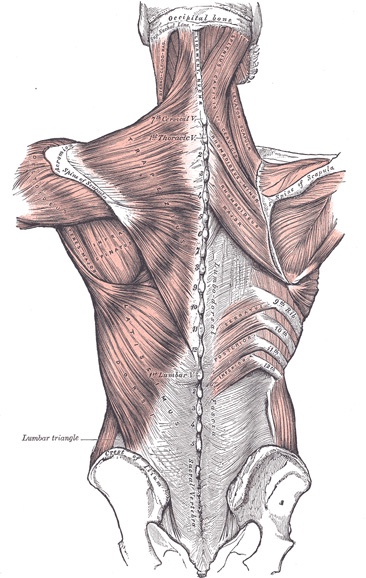
Muscles of back
Superficial and deep muscles of the back
Grey’s Anatomy

Let’s use the back muscles for an example. The superficial muscles of the back act on the upper limb. The intermediate muscles act on the ribs and thorax; the deepest muscles of the back are responsible for keeping the body erect.

If trigger points are found, the therapist may strip, friction or compress these to gain a release. Trigger points are taut bands of muscle fiber that do not relax and that keep the muscle in a shortened state. They are usually more painful than the surrounding muscle tissue, and they refer pain to other parts of the body. Trigger point therapy, also called neuromuscular therapy, is often combined with deep tissue massage. Its focus is these taut bands, and although trigger points can hurt as they are released, the therapist should not push beyond the pain threshold of a six or seven.

A true deep tissue massage focuses on the spreading and lengthening of the connective tissue sheath. Deep tissue techniques are based on the work of Ida Rolf who developed a technique called Structural Integration. Her principles have been widely adapted into other connective tissue massage therapies. 

Beneath the skin and connecting every part of the body is a fibrous sheet of connective tissue called fascia. The fascia surrounds the bones, muscles, and organs. Indeed, although it is is basically a single sheet of mesh, it wraps individual tissue fibers as well as the whole structure (ie, individual muscle fibers and the whole muscle). Thus, connective tissue health is essential to painless movement. If the surrounding fascia is restricted, so is the muscle. Denser connective tissue forms the tendons and ligaments.

Connective tissue is unique in that it is elastic, which allows it to be elongated. However, the therapist must employ precise levels of palpation, pressure and energy to effectively make changes in the tissue. Simply massaging, kneading or compressing the fascia does not change or elongate the connective tissue. Fascia and muscle are different types of tissue, and they require different approaches. Your therapist will be trained to apply these techniques.

The fascial layers are worked one at a time, progressing from superficial to deep just as with the muscle layers. The superficial layers must lengthen and become more elastic and supple before going to the next, deeper layer.

Often the reason deep tissue massage hurts is that the therapist may be trying to achieve releases too quickly. While it is appropriate to work at your pain threshold, the therapist should not exceed your threshold. If she does, it is up to you to tell her so. Furthermore, you may have to decide to forego a full-body massage and ask that the therapist concentrate on one troublesome area so she is not rushed. Alternately, you could schedule a longer massage appointment.

Finally, you need to drink water and take a hot bath in Epsom salts or apple cider vinegar when you get home. You always hear this after a massage, but do you do it? The water flushes toxins and helps keep the connective tissues hydrated so they can heal. The heat of the bath and the properties of the salts or vinegar also remove toxins and help relax the body more fully. Stretching or other exercises may also be helpful.

Deep work does not have to be painful if your therapist is knowledgeable and if you communicate with her about your pain level, You should be willing to limit your massage to a trouble area, to schedule a longer massage session, and/or to return for a follow-up visit to achieve the best results with minimal pain. Finally, you need to practice self-care and follow your therapist’s advice about proper hydration and post-massage detoxifying.

Massage & Bodywork, Self-Care & Finding True Nature, Tapestry Life Resource

Headaches and Massage

I received an email this week from a new client who has been suffering from a headache lasting a week. I remembered reading a series in Massage and Bodywork Magazine, a publication of the Associated Massage and Bodywork Professionals (AMBP)), by Til Luchau. I pulled them out and reread them. Then I did a little more research online.

Luchau divides headaches into two broad categories: tension and musculoskeletal headaches in one category and migraine and other vascular headaches in the other. I’d add a third category: sinus headache. TMJ headaches might be a fourth category, and the general protocols for TMJ jaw pain often relieve the headaches as well. However, these headaches might be better categorized as a subset of TMJ dysfunction.

Luchau provides a chart for musculoskeletal/tension and migraine/vascular symptoms in his first article.  My other research differs a bit on some points, but is in general consistent with Luchau. Understanding the symptoms is important because slightly different massage techniques are used for each type of headache. The image below offers a capsule version with hunger and eyestrain headaches omitted in the discussion that follows.

Types of headaches
Common types of headaches

Tension headaches often arise when the muscles on the shoulders, back of the neck,  under the occiput (posterior inferior cranium), and scalp become tight and pull on the scalp and the lining (dura mater) under the skull. Clenching the teeth is also a tension response and can cause headache even if  TMJ dysfunction is not present.

Usually, tension headaches occur on both sides of the head, but if the musculature on one side of the body is tighter than the other, the pain may be worse on that side.  It may also be worse in the back of the head, but depending on which muscles are hypertonic, it can be located almost anywhere. The pain is often a dull ache, but it may be more severe. It sometimes feels like squeezing or tightness in the head. Physical activity usually does not exacerbate it.

According to Luchau, the hands-on goal of working with tension headaches is to reduce the myofascial tension.

Sinus headaches are caused when the mucous membranes that line the four air-filled sinus cavities become irritated and swollen. The sinuses produce more mucus as a response, and the mucus that normally serves to moisten the air and soothe the sinuses becomes thicker and adds congestion that further blocks the sinus passages often creating a vacuum within them.

The pain is usually felt as pressure and/or tenderness  just behind the eyes, cheeks, and forehead or near the upper teeth or temple regions. The pain may worsen if you lie down although lying down may reduce the pain of tension and migraine headaches. Bending over usually makes sinus headache worse. Your face may be noticeably swollen from a sinus headache.

If the cause of a sinus headache is infection, massage is contraindicated, and you should see a doctor immediately. Otherwise, massage with a hands-on goal of stimulating lymphatic drainage and relieving blocks caused by swelling and congestion may help.

Migraines are believed to be caused when the blood vessels inside the head dilate. Many migraine remedies include vasoconstrictors for this reason. However, according to Lachau, new research may point to another cause.

“Recent research suggests that migraines start as waves of nerve cell hyperactivity sweeping across the brain; the spreading waves in turn activate pain-signaling neurons in the brain stem. The root cause of these neuro-electrical ‘brain storms’ of abnormally increased activity is unknown. The hyperactivity is followed by inhibited nerve cell excitability; the cells seem to be worn out, and this exhaustion may explain difficulty speaking or thinking clearly after migraines” (Luchau, Sept./Oct. 2010).

The pounding or throbbing, sometimes stabbing, pain of a migraine is usually focused on one side of the head. It is frequently preceded by an “aura” or visual disturbance and is accompanied by nausea and sensitivity to light, sound, and odors. Physical activity can make it worse.

Most migraine sufferers have ideas about the triggers that cause their headaches and the symptoms that signal one is starting. They may also know that the massage protocols that work on tensions headaches often have little lasting effect on a migraine. Luchau’s hands-on goal of migraine massage is to reduce cranial compression, and I would agree that even if the migraine is initially triggered by muscular tension or sinus blockage, by the time it is a full-blown migraine, work on the cranium and the cranial fascia is necessary to relieve it.

Sometimes it is hard to tell what kind of headache it is. Generally, a look at the location and quality of the pain and at the response to activity and sensory input can  help identify the type of headache you have. However, if you have a sudden, severe headache with no history of migraine headache or a dull headache that will not respond to treatment, you need to see your doctor immediately. Headaches can be a symptom of severe and even life-threatening conditions, stroke for example, and should not be ignored.

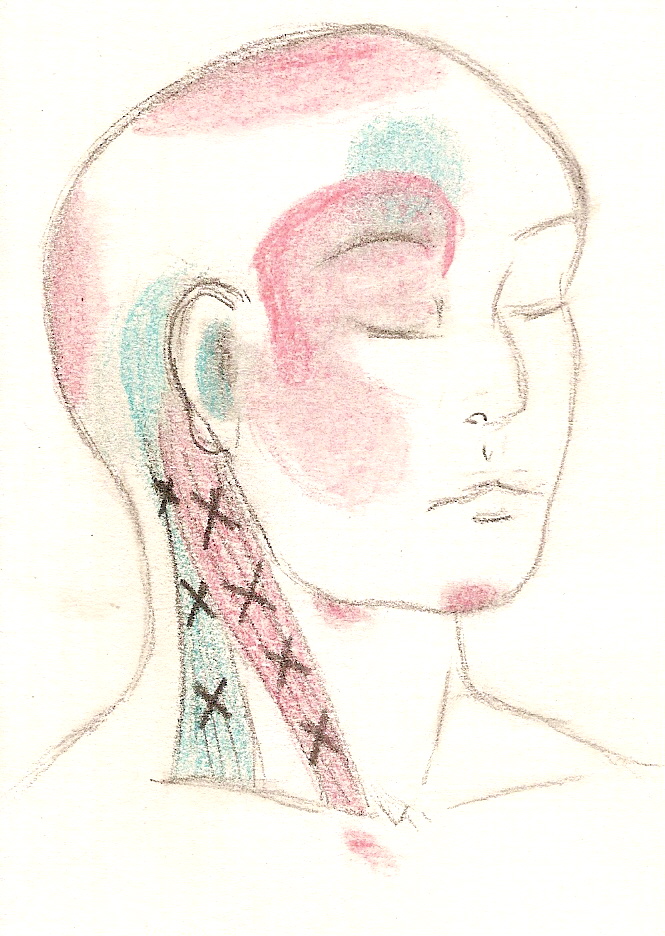
sternocleidomastoid trigger points

The massage protocol for a tension headache will include release of tight neck, shoulder and chest muscles and general relaxation strokes. Luchau’s first article emphasized release of the superficial and deep fascia of the scalp and a concentration of the suboccipital regions. I would add trigger point therapy of specific muscles likely to contribute to headache pain. Indeed, numerous research studies have cited the efficacy of massage, including specific pain-relieving modalities and more general relaxation type massage which tends to improve overall structural alignment and release endorphins into the body, as greatly relieving symptoms of tension headaches and even preventing headache recurrence when massage is received regularly.

Sinus massage with use of lymphatic drainage therapy is effective for relieving the pressure in the sinuses. (See my recent newsletter article on Sinus Massage.) The Lymph Drainage Therapy technique is slow and precise, and it uses feather-light strokes to move the lymph out of the head and into the nodes. It may also include the use of aromatherapy to further open the sinus passages.

Migraine headaches respond well to Craniosacral Therapy, especially intraoral work. CST allows the therapist to decompress the bones of the cranium and balance the blood flow. It also allows for structural realignment.  Luchau’s technique uses a little more pressure than CST, but it is similar. (Trigger point therapy is often not as effective on migraines and on tension headaches.)

According to Luchau, the effect of this cranial work may be to reduce the pressure on the trigeminal nerve or to affect the hypothalamus and pituitary glands which may be responsible for the “brainstorm” of  nerve cell hyperactivity mentioned in the quote above  (Luchau, Nov./Dec. 2010).

Regular massage may also increase serotonin levels in migraine sufferers and thus prevent recurrence. Serotonin is a neurotransmitter and low serotonin levels have been indicated in migraine sufferers. Low serotonin also causes depression, seasonal affective disorder, addictions and eating disorders.

Two other modalities that seem to reduce headache pain are Myofascial Release and Reiki. Myofascial Release used gentle, light traction and stretching to release the fascia, which is a single sheath of connective tissue that covers the muscles, bones, organs, and even the cells (everything!) inside your body. Craniosacral therapy and lymph drainage therapy always incorporate myofascial release as do other modalities, but it can be used as a “stand-alone” modality. Reiki is one of a number of energy modalities that can be used to work on the subtle energy body. In many cases, this gentle therapy alone can relieve the headache.

Massage has been proven in study after study to decrease the severity and frequency of headaches. When you see your therapist, be sure to tell her the following to help her determine the best therapy protocol for your specific needs:

  • Where your pain is located
  • How long you’ve had the pain and if it comes and goes
  • How often you have headaches in general
  • If you’ve seen a physician and if so, what is the diagnosis
  • What precipitated the headache if you know
  • What is the quality of the pain (dull, throbbing, stabbing)
  • How movement and sensory stimulus affect the pain levels
  • What you have done to relieve it, such as taking pain relievers or using cold compresses, before coming to her

Headaches do not have to be a fact of life. Self-care and regular massage can be of great help in preventing them and relieving them when they do occur.


Sources:
Institute for Integrative Health Studies. (2005, July 21). The dual concept massage approach to headaches. Retrieved from http://www.integrative-healthcare.org/mt/archives/2005/07/the_dual_concep.html.

Luchau, T. (2010, July/August). Working with headaches, part 2. Massage and Bodywork, XXV(IV), 111.  Retrieved from http://massagebodywork.idigitaledition.com/issues/13

Luchau, T. (2010, September/October). Working with headaches, part 2. Massage and Bodywork, XXV(V), 111.  Retrieved from http://massagebodywork.idigitaledition.com/issues/14.
Luchau, T. (2010, November/December) Working with headaches, part 3. Massage and Bodywork, XXV(VI), 111-112.  Retrieved from
Ulrich, C. (2010). Holding headaches at bay. Retrieved from http://www.massagetherapy.com/articles/index.php/article_id/1058/Holding-Headaches-at-Bay-.