Thoughts on Body, Heart, and Mind by Suzanne Eller
Category: Massage & Bodywork
Thoughts on the power of touch to transform lives for both the giver and receiver and on the attributes and applications of different bodywork modalities.
The skin is our largest sensory organ. Massage can create a sense of peace and well-being through the power of touch.
It is sometimes easy to emphasize the physical benefits of massage and forget the mental health benefits of regular bodywork. The physical benefits are more immediately recognizable, but the mental benefits can be more lasting.
Numerous clinical trials have evaluated the effects of massage on mental and emotional health, and the results are impressive. For example, studies indicate that massage and psychotherapy given to women suffering from postpartum depression had significantly greater improvement in both depression and anxiety than did groups who received only psychotherapy.
Similar results were found for individuals other than new mothers suffering from depression and anxiety. Other studies indicate that massage may help people who suffer from ADHD, Alzheimer’s disease, and bipolar disorder, to name a few.
Jacqueline Young, author of Complementary Medicine For Dummies, (London: Wiley Publishing, 2007) gives evidence for the efficacy of massage in treating those with eating disorders. She says more and more clinics treating anorexia and bulimia are finding that massage helps clients reduce anxiety about their appearance and improve their body image.
Massage reduces levels of stress hormones, especially cortisol (which, by the way, can make you fat!) It increases the activity of the parasympathetic nervous system (“rest and digest”) and decreases the activity of the sympathetic nervous system (“fight or flight”). Improved parasympathetic response means greater availability of brain chemicals like serotonin, oxytocin, and endorphins (natural painkillers).
Another benefit of massage is to meet our need for safe, human touch. Human beings can literally die without human touch, and studies have shown the devastating lack of emotional development in babies who are not adequately held and cuddled. Still, we live in a world where those who touch inappropriately have caused all of us to be a little suspect of too much touching. When there is a lack of touch in a person’s life, massage can fill the void and create peace-of-mind. Overall well-being is enhanced.
Massage provides the following mental health benefits:
Increases mental alertness and improves concentration and memory.
Reduces anxiety and increases sense of overall well-being and self-confidence.
Reduces stress hormone levels and increases production of mood-enhancing brain chemicals.
Provides an overall calming effect and lowers irritability.
Lowers brain wave activity to the alpha state, which provides a feeling of relaxation and increases creativity and organizational ability.
Calms the nervous system and improves synaptic response.
Relieves fatigue and renews energy levels.
There is also a relationship between mental health and physical ailments. Many of us carry stress in our bodies. Idioms like “he’s a pain in my neck” and “my job’s a headache” reflect physical responses to stress-causing people and situations. Massage can help relieve the stress before it manifests as a physical symptom.
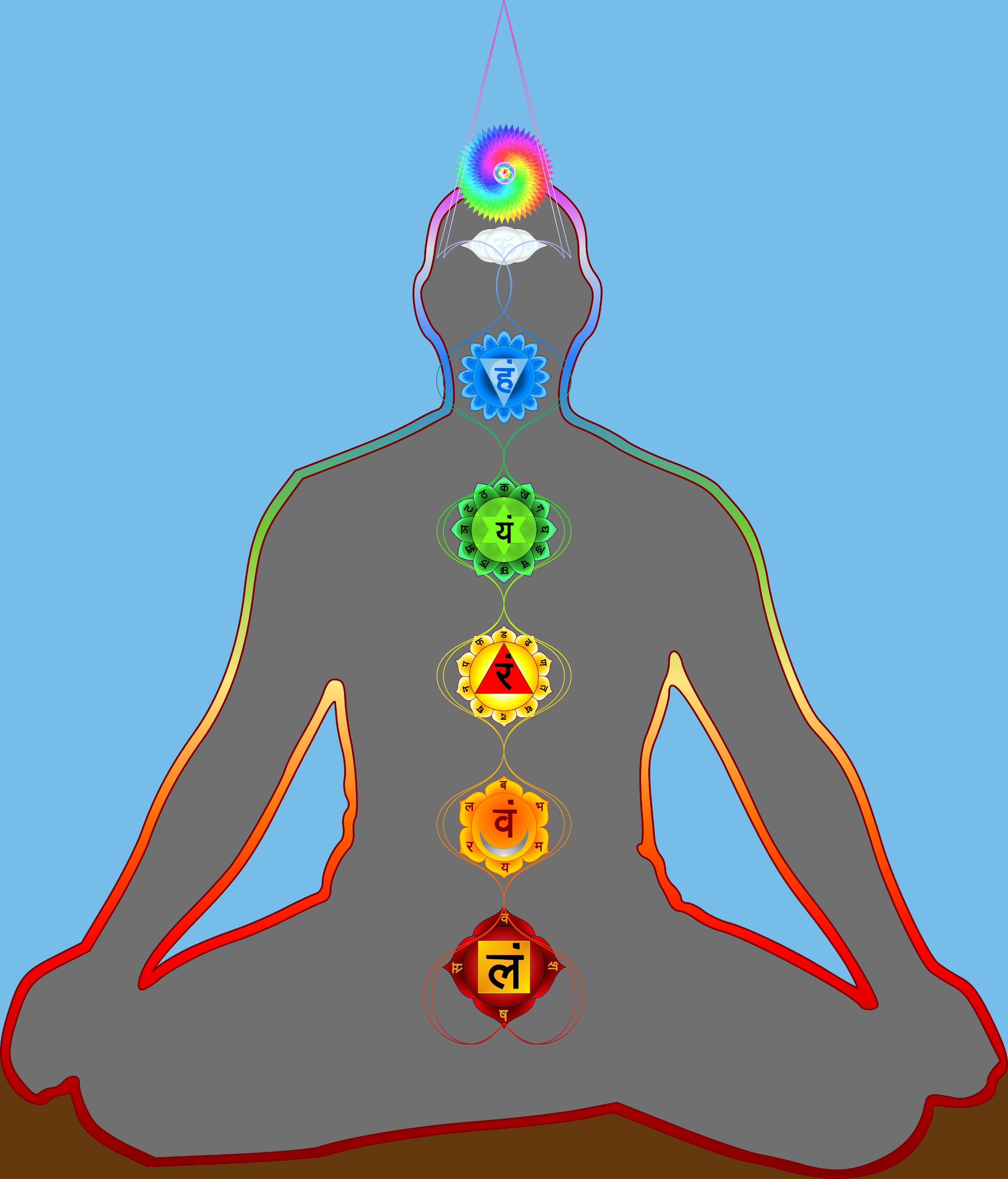
Aryuvedic tradition describes seven major energy centers that run along the spine and spiral out the front and back of the body in clockwise vortices. The Sanskrit word for these centers is chakra, meaning “wheel of light”.
From Wikimedia Commons. Modified from original by Mirzolot2.
Modern research in physics and biophysics suggests that these energy centers are also the sites of consciousness, which means consciousness is located throughout our bodies, not just in our brains. It also means that though most of us cannot see chakras, their health is vital to our humanity and our optimal growth.
Each of the seven major chakras corresponds to an electromagnetic field or “body” sometimes called the aura. Disruptions to the healthy functioning of the chakras can be detected in one or more layers of the auric field by trained energy workers and special machines that measure or photograph the electromagnetic charge and the photons emitted. They are probably picked up unconsciously by everyone. That is why some people calm us while others give off “bad vibes”.
Each of the seven major chakras seems to exert influence over specific physical, emotional, mental, and spiritual functions. For example, a disruption of the throat chakra might show up as thyroid problems, timidity, inability to express oneself clearly, and conflict between actions and religious convictions. (See forthcoming articles on each chakra for more information.)
Besides the seven major chakras, there are numerous secondary chakras throughout the body, most commonly located at the joints and nerve plexuses including the palms of the hands. Biophysicists across the world have shown that these secondary chakras may be responsible for a kind of cellular communication within our own bodies and between ourselves and others on an unconscious level. For example, mothers and children may literally communicate through light and other frequencies emitted from the secondary chakras so that a mother knows when her child is hurt or the child knows when the mother is gone. Dysfunction of the secondary chakras can cause delays in the healing process and/or a breakdown in the immune response.
One of the most respected teachers of chakra theory in the western world is Rosalyn L. Bruyere. She has been studied by such scientists as Dr. Valerie V. Hunt at UCLA in the famous Rolfing Study (Rolfing is a kind of massage), Dr. Fritz Albert Popp in a biophoton research study, Dr. Elmer Green in studies at the Menninger Clinic, and in a study on brain-damaged children at the Kennedy Krieger Institute of Johns Hopkins University, to name a few. Her web-site has links to many f these studies.
Bruyere is also the teacher of other respected energy healers. One of the most well-known of these is Barbara Brennan, who is renowned world-wide for her work with chakras as well.
According to Bruyere, aligning any one chakra helps to align the others, and while it is usual for energy workers to discuss chakras as being open or closed, it is more accurate to say that they are blocked or that the energy flow of a particular chakra is inhibited. Similarly, chakras can be over-excited, which also causes disease.
Bruyere also says that each chakra has a viewpoint or “prime directive”. When one of our chakras is over- or under-functioning, we have too much or too little of that chakra’s viewpoint in our lives. This will be discussed in more detail when we explore the function of each chakra.
“It has taken thousands of years, but within this century both scientists and spiritual seekers alike have once again begun to view the laws of nature and the laws of God as reflections of the same truth.” ~Rosalyn L. Bruyere
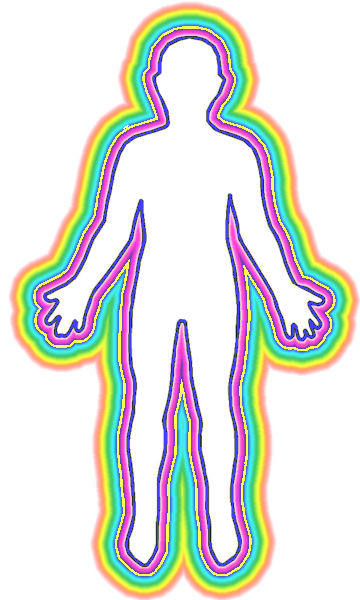
The aura surrounds the physical body in layers. Public domain image.
The auric field is has been measured by scientists as electromagnetic current that extends through and from the body for at least six feet, more or less, in the average healthy person. As each chakra spins, it creates its own electromagnetic field, which in turn combines with the other chakra fields to produce the aura. Each chakra ans the corresponding field have a particular frequency or vibration. With practice, you can feel the frequency of the field and of the chakra.
Bruyere’s book, Wheels of Light, includes a chapter in the appendix that gives the scientific research into verification of the aura. Barbara Brennan’s book, Hands of Light, gives one of the best descriptions of the correspondence between chakra and auric field. I am using Brennan’s descriptions of the aura here. She describes them as being in layers, with the etheric layer closest to the physical body.
However, it should be noted that other authors may disagree with Brennan because sensing the aura and the chakras is somewhat subjective to the energy worker him/herself despite the plethora of scientific research. That is one reason energy medicine is still having trouble achieving respectability among scientists who follow Newtonian rather than quantum physics. Likewise, the descriptions of the chakras and the aura are at least as old as the Hindu Upanishads. As with all ancient wisdom, understanding of the chakra system varies in interpretation from generation to generation as personal experience and now scientific verification adds to the body of knowledge.
The first chakra, called in Sanskrit the Muladhara, meaning wheel of the root/support. It is considered to be the seat of the physical body and is located the the base of the spine. It creates what Brennan calls the etheric body in the aura. It is equivalent to a blueprint for the physical body and is the densest and most easily sensed of the auric layers. Those who can see auras may describe it as looking like blue or gray vertical grid lines. It can be sensed in other living things as well though the color may vary according to the organism.
The second chakra in Sanskrit is called the Swadisthana or Svadisthana, meaning the abode of self. It is situated just behind and below the navel near the sacrum, and in Taoism and Traditional Chinese Medicine it is called the hara or tan tien. It creates what Brennan calls the emotional body. She describes it as being more fluid than the etheric body and varying in colors somewhat like many colored clouds. The colors change from brilliant to dull according to the emotional condition of the person. For example, clear feelings whether they be love or anger are brighter whereas confused feelings are darker and duller.
Manipura is the Sanskrit name for the third chakra. It means wheel of the jeweled city. Located on the spine near the solar plexus, it creates the mental body in Brennan’s description. Like the etheric layer, it is more structured and is mostly yellow in color. It, too, has a grid-like quality but not so pronounced as the etheric body. Brennan says it expands and becomes brighter when we concentrate or think deeply. It may also change color if we are engaged in habitual thought processes almost as if we are giving our thoughts literal form.
The fourth chakra is located near the heart and is called in Sanskrit Anahata, meaning wheel of the unstuck. It creates the astral body of the aura. Like the emotional body, it is composed of clouds of color, but Brennan says they are more beautiful and have a rose tint that indicates the influence of the chakra’s connection with love on the auric layer. Indeed, she says the layer becomes more rosy when we fall in love. Apparently, we connect with people through the energy of this auric layer, and the connection can be pleasant or not depending on the intentions that pass between us. Research done at the Heartmath Institute seems to confirm this assumption.
The fourth chakra marks a connecting point. While it is a common mistake to assume the lower chakras are somehow “less-than” the upper ones, the lower chakras are more concerned with incarnational, physical existence in the manifest world. The upper three chakras are typically described as influencing our spiritual nature. The heart chakra is the bridge that connects the mundane and the spiritual. However, one aspect is no less important than another. All parts of us make the whole, and blocks in any one chakra affect all of our being.
The fifth or throat chakra is on the cervical spine and is called in Sanskrit Vishuddha, meaning pure wheel. Brennan calls the firth layer the etheric template because it “contains all the form that exist on the physical plane in a blueprint or template form” (Brennan 52). She describes it as looking somewhat like a photographic negative though it does have cobalt blue grid lines just like the etheric layer that it supports and creates.
“The etheric template level of the aura creates an empty or negative space in which the first or etheric level of the aura can exist. The etheric template is the template for the etheric body, which then forms the grid structure … upon which the physical body grows.” ~Barbara Brennan
The sixth chakra is sometimes called the third eye or brow chakra because of its location at the top of the spine and in the midbrain. In Sanskrit it is called Ajna, which means command wheel. Brennan calls the body that corresponds to Ajna the celestial body. It is the emotional layer of the spiritual plane. It has pastel colors and an opalescent shine. It is associated with spiritual connection to God, the universe and all creation and is characterized by unconditional love. Just as the fifth layer helps support and create the first auric layer, the sixth layer supports and creates the second or emotional layer.
The seventh chakra is the Sahasrara in Sanskrit and means thousand-petaled wheel. It is located at the crown of the head. The crown chakra creates the ketheric template or the causal body. It is the mental level of the spiritual body and forms the outer, golden-silver egg-shape of the auric field. It is the strongest and most resilient level of the auric field. It is at this level that we know we are one with the creator.
Science has shown that disease often shows up in the aura before it shows up in the physical body. However, energy healing is not some esoteric or psychic ability that only a few gifted people are blessed to have. Naturally, there are some who more natural ability and others who have developed their abilities more than the rest of us, just like there are some athletes that can run faster than the rest of us. However, we all have the ability to use energy to heal, and we do so whether we realize it or not. We don’t have to see or sense auras to do it, either.
Every time a mother kisses a “boo-boo” to make it well or a friend holds the hand of sick loved-one, we share healing energy. Sometimes it sounds pretty woo-woo, but it is truly one of the most basic ways in which we relate and support one another. It is likely the way that Jesus healed, and he told us that what he could do, we could also.
Learning about the energy field can make us more sensitive to it, but we should all remember that any loving-kindness we show to each other and all loving thoughts have healing potential.
Bibliography
Brennan, Barbara. Hands of Light: a Guide to Healing through the Human Energy Field. New York: Bantam Books, 1988.
Bruyere, Rosalyn L. Wheels of Light: Chakras, Auras, and the Healing Energy of the Body. New York: Fireside Books, 1994.
Childre, Doc and Howard Martin. The HeartMath Solution: The Institute of HeartMath’s Revolutionary Program for Engaging the Power of the Heart’s Intelligence. New York: HarperCollins Publishers, Inc., 1999.
Dale, Cyndi. The Subtle Body: An Encyclopedia of Your Energetic Anatomy .Boulder, CO: Sounds True, Inc., 2009.
Ellis, Richard. Reiki and the Seven Chakras: Your Essential Guide. London: Vermillion, 2000.
Hunt, Valerie V. Infinite Mind: Science of the Human Vibrations of Consciousness. Malibu: Malibu Publishing, 1996.
Joy, W. Brugh. Joy’s Way.New York: Tarcher/Putnam, 1979.
McLaren, Karla. Your Aura and Your Chakras: The Owner’s Manual. York Beach, ME: Samuel Weiser, Inc., 1998.
McTaggart, Lynne. The Intention Experiment. New York: Free Press, 2007.
Myss, Caroline. Anatomy of Spirit: The Seven Stages of Power and Healing. New York: Harmony Books, 1997.
Schwartz, Gary E. The Energy Healing Experiments: Science Reveals Our Natural Power to Heal. New York: Atria Press, 2007.
Voigt, Anna. The Chakra Workbook: A Step-by-Step Guide to Realigning Your Body’s Vital Energies. San Diego: Thunder Bay Press, 2003.
I received an email this week from a new client who has been suffering from a headache lasting a week. I remembered reading a series in Massage and Bodywork Magazine, a publication of the Associated Massage and Bodywork Professionals (AMBP)), by Til Luchau. I pulled them out and reread them. Then I did a little more research online.
Luchau divides headaches into two broad categories: tension and musculoskeletal headaches in one category and migraine and other vascular headaches in the other. I’d add a third category: sinus headache. TMJ headaches might be a fourth category, and the general protocols for TMJ jaw pain often relieve the headaches as well. However, these headaches might be better categorized as a subset of TMJ dysfunction.
Luchau provides a chart for musculoskeletal/tension and migraine/vascular symptoms in his first article. My other research differs a bit on some points, but is in general consistent with Luchau. Understanding the symptoms is important because slightly different massage techniques are used for each type of headache. The image below offers a capsule version with hunger and eyestrain headaches omitted in the discussion that follows.
Common types of headaches
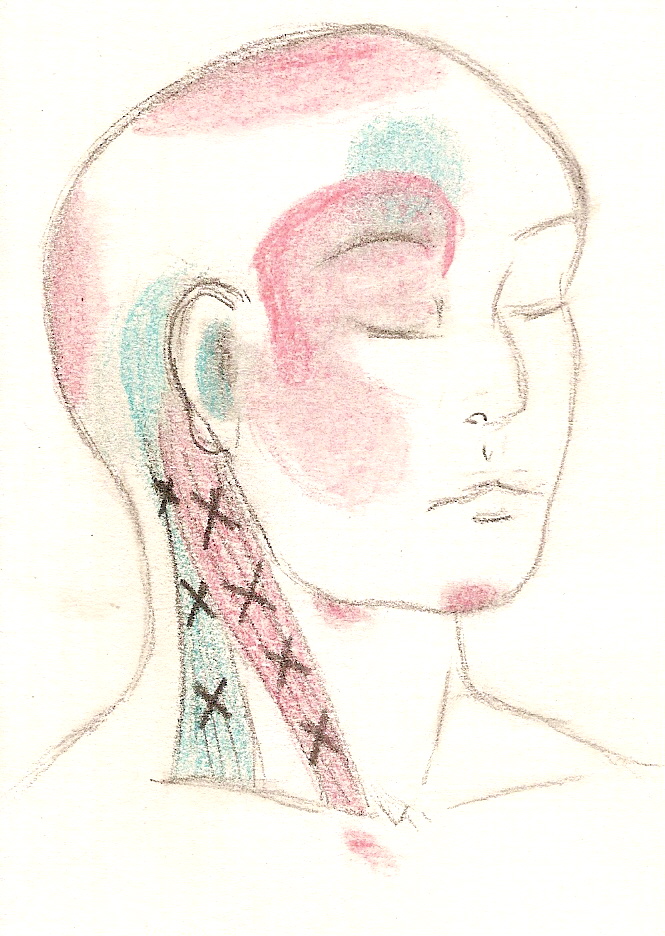
Tension headaches often arise when the muscles on the shoulders, back of the neck, under the occiput (posterior inferior cranium), and scalp become tight and pull on the scalp and the lining (dura mater) under the skull. Clenching the teeth is also a tension response and can cause headache even if TMJ dysfunction is not present.
Usually, tension headaches occur on both sides of the head, but if the musculature on one side of the body is tighter than the other, the pain may be worse on that side. It may also be worse in the back of the head, but depending on which muscles are hypertonic, it can be located almost anywhere. The pain is often a dull ache, but it may be more severe. It sometimes feels like squeezing or tightness in the head. Physical activity usually does not exacerbate it.
According to Luchau, the hands-on goal of working with tension headaches is to reduce the myofascial tension.
Sinus headaches are caused when the mucous membranes that line the four air-filled sinus cavities become irritated and swollen. The sinuses produce more mucus as a response, and the mucus that normally serves to moisten the air and soothe the sinuses becomes thicker and adds congestion that further blocks the sinus passages often creating a vacuum within them.
The pain is usually felt as pressure and/or tenderness just behind the eyes, cheeks, and forehead or near the upper teeth or temple regions. The pain may worsen if you lie down although lying down may reduce the pain of tension and migraine headaches. Bending over usually makes sinus headache worse. Your face may be noticeably swollen from a sinus headache.
If the cause of a sinus headache is infection, massage is contraindicated, and you should see a doctor immediately. Otherwise, massage with a hands-on goal of stimulating lymphatic drainage and relieving blocks caused by swelling and congestion may help.
Migraines are believed to be caused when the blood vessels inside the head dilate. Many migraine remedies include vasoconstrictors for this reason. However, according to Lachau, new research may point to another cause.
“Recent research suggests that migraines start as waves of nerve cell hyperactivity sweeping across the brain; the spreading waves in turn activate pain-signaling neurons in the brain stem. The root cause of these neuro-electrical ‘brain storms’ of abnormally increased activity is unknown. The hyperactivity is followed by inhibited nerve cell excitability; the cells seem to be worn out, and this exhaustion may explain difficulty speaking or thinking clearly after migraines” (Luchau, Sept./Oct. 2010).
The pounding or throbbing, sometimes stabbing, pain of a migraine is usually focused on one side of the head. It is frequently preceded by an “aura” or visual disturbance and is accompanied by nausea and sensitivity to light, sound, and odors. Physical activity can make it worse.
Most migraine sufferers have ideas about the triggers that cause their headaches and the symptoms that signal one is starting. They may also know that the massage protocols that work on tensions headaches often have little lasting effect on a migraine. Luchau’s hands-on goal of migraine massage is to reduce cranial compression, and I would agree that even if the migraine is initially triggered by muscular tension or sinus blockage, by the time it is a full-blown migraine, work on the cranium and the cranial fascia is necessary to relieve it.
Sometimes it is hard to tell what kind of headache it is. Generally, a look at the location and quality of the pain and at the response to activity and sensory input can help identify the type of headache you have. However, if you have a sudden, severe headache with no history of migraine headache or a dull headache that will not respond to treatment, you need to see your doctor immediately. Headaches can be a symptom of severe and even life-threatening conditions, stroke for example, and should not be ignored.
The massage protocol for a tension headache will include release of tight neck, shoulder and chest muscles and general relaxation strokes. Luchau’s first article emphasized release of the superficial and deep fascia of the scalp and a concentration of the suboccipital regions. I would add trigger point therapy of specific muscles likely to contribute to headache pain. Indeed, numerous research studies have cited the efficacy of massage, including specific pain-relieving modalities and more general relaxation type massage which tends to improve overall structural alignment and release endorphins into the body, as greatly relieving symptoms of tension headaches and even preventing headache recurrence when massage is received regularly.
Sinus massage with use of lymphatic drainage therapy is effective for relieving the pressure in the sinuses. (See my recent newsletter article on Sinus Massage.) The Lymph Drainage Therapy technique is slow and precise, and it uses feather-light strokes to move the lymph out of the head and into the nodes. It may also include the use of aromatherapy to further open the sinus passages.
Migraine headaches respond well to Craniosacral Therapy, especially intraoral work. CST allows the therapist to decompress the bones of the cranium and balance the blood flow. It also allows for structural realignment. Luchau’s technique uses a little more pressure than CST, but it is similar. (Trigger point therapy is often not as effective on migraines and on tension headaches.)
According to Luchau, the effect of this cranial work may be to reduce the pressure on the trigeminal nerve or to affect the hypothalamus and pituitary glands which may be responsible for the “brainstorm” of nerve cell hyperactivity mentioned in the quote above (Luchau, Nov./Dec. 2010).
Regular massage may also increase serotonin levels in migraine sufferers and thus prevent recurrence. Serotonin is a neurotransmitter and low serotonin levels have been indicated in migraine sufferers. Low serotonin also causes depression, seasonal affective disorder, addictions and eating disorders.
Two other modalities that seem to reduce headache pain are Myofascial Release and Reiki. Myofascial Release used gentle, light traction and stretching to release the fascia, which is a single sheath of connective tissue that covers the muscles, bones, organs, and even the cells (everything!) inside your body. Craniosacral therapy and lymph drainage therapy always incorporate myofascial release as do other modalities, but it can be used as a “stand-alone” modality. Reiki is one of a number of energy modalities that can be used to work on the subtle energy body. In many cases, this gentle therapy alone can relieve the headache.
Massage has been proven in study after study to decrease the severity and frequency of headaches. When you see your therapist, be sure to tell her the following to help her determine the best therapy protocol for your specific needs:
Where your pain is located
How long you’ve had the pain and if it comes and goes
How often you have headaches in general
If you’ve seen a physician and if so, what is the diagnosis
What precipitated the headache if you know
What is the quality of the pain (dull, throbbing, stabbing)
How movement and sensory stimulus affect the pain levels
What you have done to relieve it, such as taking pain relievers or using cold compresses, before coming to her
Headaches do not have to be a fact of life. Self-care and regular massage can be of great help in preventing them and relieving them when they do occur.
Foot care is especially important for the diabetic. Have your therapist look for cracks and ulcerations and be aware of too deep pressure you might not feel. Image by HealingDream at FreeDigitalPhotos.net Click link at end of article to see HealingDream's portfolio.
One of my personal goals is to learn something new about massage and bodywork each day. Sometimes that is a new technique, and sometimes it is new information about a pathology or condition presented by one of my clients.
One of my regular, weekly clients has mild Type II diabetes. She also suffers from being overweight and from arthritis, and although very active in her life, her range of motion is impaired by her ailments. Massage and regular chiropractic appointments make her feel better and help improve her ability to do the things she enjoys with greater ease of movement.
I’ve been trying to discover the reason for her toe cramps for a while now. Other massage therapists have suggested that these might be caused by mineral deficiencies (potassium, magnesium, and calcium primarily), dehydration or by the massage releasing a muscle and thus causing the antagonist areas go into spasm. My client has tried many of the suggested remedies, plus homeopathic quinine and switching to lite potassium chloride salt. She even put a cork under her pillow although that folk remedy didn’t work.
My client’s regular doctor suggested, however, that the cramps might be related to her diabetes. That led me to do more research, and I’ve learned a good bit in the last week about diabetes and massage.
First, I learned that if the cramping is related to the diabetes, it may be coming from the drug she is using to control her sugar levels. The cramping may also be a complication of Type II diabetes itself though it is not as well-known as neuropathy or even the skin hardening that may precede neuropathy. Ulcerated skin is one of the worst of these related complications, so while I advise using the mineral supplements with the doctor’s approval, I also want my client to be vigilant for any decrease in feeling in her feet and toes.
I also learned some general things about diabetes and massage. In general, massage is beneficial for people who have diabetes. Massage helps the client relax and release endorphins which in turn helps blood sugar levels balance to healthy levels. Similarly, massage improves circulation, which in turn improves cellular insulin uptake. Finally, regular massage improves the elasticity of the connective tissue and makes movement easier.
This last benefit got me thinking about how often the superficial tissue of my diabetic clients seems stretched unusually taut and how often even light pressure seems to cause an unusual pain response. So I began to do more digging. What I discovered is that increased blood sugars cause connective tissues to thicken and even harden. The is true of the superficial fascia and also of the deeper fascia that surrounds the muscles, muscle fibers and the organs themselves. The thickening also causes swelling because lymph flow is restricted and further inhibits the range of motion. The skin itself can become dry, calloused and cracked. No wonder my client hurts!
I always work slowly, releasing the superficial connective tissue before working individual muscles. This is the way I was taught and is also an intuitive response as I palpate the tissues. Working slowly and broadly with long strokes, myofascial stretching and energy techniques first relaxes and releases the dense connective tissue before I begin using more specific deep tissue pressure and trigger point therapy on individual muscles.
I remember this same client telling me that her previous massage therapist often made her hurt for several days before she felt better. I suspect the MT went into the trigger points too quickly and caused damage to the connective tissue by not warming and melting it first. Now that I know about the effect of diabetes on the cellular density of the tissue, I will be even more careful to warm the tissue and proceed slowly to the deeper layers.
Another thing I learned is both a benefit and a caution. Massage can cause the blood sugar levels to drop as much as 20-40 points. Overall, this is a good thing, but if the client’s blood sugar levels drop too much while on the table or just after the massage, it could cause hypoglycemia and be dangerous. That defeats all the potential benefits of the relaxing massage.
Symptoms of a dangerous drop in blood sugar levels include:
Excessive sweating or clammy skin
Faintness or headache
Inability to awaken
Certain “spaced-out” tendencies, such as slow speech or clumsiness
Irritability
Personality changes
Rapid heartbeat
That’s why I went out to the store and bought some fruit juice boxes to have on hand in case I have a client on the table whose sugar drops too much. However, if you are diabetic and receive massage, you should have a snack in your purse or car and always tell the therapist if you need to stop the massage and take care of your blood sugar needs. I assure you, the therapist will be thankful. You also need to check your blood sugar levels for several hours after you leave the massage office because the effects of blood sugar lowering can continue for several hours.
Be sure to update your therapist about what medications you are taking, especially if you are taking insulin shots. The injection sites are particularly sensitive to massage, and although the tissue there may feel especially dense (causing the therapist to work there more), studies have shown that massage on injection sites can increase the rate at which the insulin enters the blood stream and further lower your blood sugar.
Finally, be sure you eat before the massage and that you are hydrated both before and after the massage. If you feel unusual, after the massage, don’t drive until you feel normal.
The beneficial effects of massage for diabetics seem to outweigh the contraindications. However, it is a must that you and your massage therapist communicate effectively. Share you needs and concerns, and realize that honest feedback allows you and your massage therapist to learn from each other and develop a supportive rapport.
I just returned from the AMTA-NC conference in Cary, NC, and spent two days learning techniques of Hawaiian Lomi Lomi massage from Brenda L. Griffith.
It was an amazing two days, not only because I got to network with other massage therapists, which is one of the benefits of belonging to AMTA, but because the techniques I learned easily incorporate themselves into my massage protocol. In fact, I’ve used some piece of what I learned in every massage that I’ve given over the last week.
Griffith, who is a former AMTA national president, studied with Aunty Margaret Machado in Hawaii in 1994 and 1995, and has taught classes in Lomi Lomi all over the United States. We spent most of the two days actually giving or receiving the work. The Lomi Lomi strokes are long and fluid and have been said to resemble a dance because the therapist moves her whole body to apply rather deep and yet soothing pressure through gravity and leverage.
Lomi Lomi is intuitive work. At the beginning of the session, the therapist sets her intention to help the client receive the greatest benefit and allow his/her body to balance and heal. Then using rhythmic, fluid motions with the forearms and the fleshy parts of the hands rather than relying on fingers and thumbs, the therapist uses long, full-body strokes to release blocked energy and tissues. Lomi Lomi feels wonderful to recieve, and as a therpist, I thouroughly enjoy giving the massage to others. It is almost as relaxing to give a Lomi Lomi massage as to receive one.
“Touch the body with a loving touch.
If your hands are gentle and loving,
Your patient will feel the sincerity of your heart.
His soul will reach out to yours,
And the Lord’s healing will flow through you both.”
~Aunty Margaret
Some of you will remember that a few years ago, I took a class in Huna from Angela Sherrill. Huna is the philosophy that underpins Lomi Lomi. Huna teaches that everything in the universe seeks harmony and love. Is it any surpise that one of the alternate names for Lomi Lomi is “loving hands massage”? With long, continuous, flowing strokes over the client’s body, Lomi Lomi’s goal is to nurture the client and help him/her relax and simply be. What could be more loving?
Each of my clients who has experienced Lomi Lomi since I returned from Cary has loved it. Two of the regulars commented, “That’s new, isn’t it? I like it.”
For that reason alone, I appreciate the work. Moreover, I really like the emphasis on resonating with the client from the beginning to the end of the massage and relying on my intuitive sense of what the client needs to tell me what to do next. I also like the gentleness of the work and its profound ablility affect the tissues deeply without causing pain. Finally, I like that it follows the philosophy of Huna, which emphasizes love, tolerance, acceptance, respect, and compassion for all beings; Huna has an energy work component that I’ve been using for some time now.
This week I am planning to do my first full Lomi Lomi massage since the class rather than just incorporting pieces of it into the massages I am already giving. I’ll switch from cream to oil, and I’ll try to use most of the techniques I learned. I am looking forward to that. However, I am sure I’ll continue to use parts of Lomi Lomi, just as my teacher Brenda L. Griffith does, in nearly every massage I give.
Stress can wreak havoc on the body. Massage can help relieve stressors and initiate the parasympathetic "rest and digest" response. Image by Renjith Krishnan at FreeDigitalPhotos.net. To see Renjith's portfolio, click the link at the end of the post.
If the economic downturn and summer vacation expenses have got you thinking that you need to cut back on spending, you are not alone. But if you’re thinking, “Massages are a luxury that I can easily forego,” think again. Massages are an investment in your health.
The recent discussion in Congress about the drain on our country’s resources by healthcare costs has made us aware that poor health is expensive. Besides lost workdays, the costs of visits to the doctor and medications can mount up even if you are insured.
That’s not even putting a value on the time you spend in waiting room or on the quality of life lost when you are debilitated by pain and disease.
Receiving massage from a capable, qualified massage therapist can relieve pain and greatly improve your physical and emotional health.
Therapeutic massage:
Increases circulation thereby benefiting the organs and muscles on a cellular level by increasing their oxygen and nutrient supply;
Stimulates the lymphatics thus supporting the body’s natural immune response;
Flushes toxins from the tissues;
Stimulates the parasympathetic nervous system, improving the “rest and digest” response (and calming “fight or flight”);
Loosens adhesions in the fascia and tissues;
Relieves chronic pain;
Provides “safe touch” for people who don’t otherwise receive tactile contact (touch helps reduce stress);
Relieves anxiety and emotional stressors;
Releases endorphins to promote feelings of well-being and reduce depression.
Wow! With all the benefits of massage, it looks like Congress would add that the the healthcare package!
The fact is we are living in the greatest economic downturn since the Great Depression. And besides the financial stressors and threats of job loss, we are coping with the ordinary demands that plague us anytime, such as the demands of families, friendships, loss, transitions, illness, pain, and similar circumstances.
Massage can help you deal with these stressors and can help you maximize the return on your other self-care measures.
Regular massages are a sound investments. Pain and stress are expensive. Getting a massage is an investment in your future health.
I attended the AMTA-NC Conference (American Massage Therapy Association) in Hickory over the past weekend. It was a wonderful experience. I took some wonderful continuing education— one on Deep Tissue Made Easy taught by Eric Stephenson was especially good— made some new friends and visited with old ones, and met some vendors with whom I’ll probably continue to do business.
Before I became a massage therapist, I was a teacher. I have always belonged to my professional organizations, and I find it hard to understand when others don’t. The reason I most often hear is that the professional groups are too expensive. However, I would counter that it is more expensive not to join. I certainly get direct personal value for my money, and I have a voice on a state and national level that I wouldn’t have otherwise.
For example, this first of two AMTA-NC Conferences this year cost me $200, which was $100 less than for attendees who were not AMTA members. For that I got 15 hours of usable continuing education. I went to the AMTA volunteer luncheon, so I ate one meal free, and the night before I went to the AMTA social that had heavy hors d’oeuvres and let that be my dinner. During both these meals, I interacted with other AMTA massage therapists and felt the kind of cameraderie that comes from being with people who share the same passion. The conference was held in my town, so I didn’t have to get a motel room. The fall 2009 Conference was in a nearby city, and again I drove. The next one will be in Cary, which will mean I have to find a place to stay, but those two nights won’t be too much extra considering I will have gotten 45 hours of continuing education for about $600, networked with other MTs who may send me referrals, and met teachers, vendors and MTs who can give me usable ideas that I can apply to my business now. As a member, I can also go to any of the district continuing education offerings in the state and learn other techniques for a reasonable cost. I can even check out videos of different modalities from the AMTA-NC library for free and further expand my knowledge base.
On a state and national level, the AMTA supports me by lobbying for legislation that maintains the integrity of massage therapists as professionals and balances the amount of regulation between what keeps us safe and reputable and what limits our ability to do our jobs. So far, I have no grievances with how this is being done or with how I am being informed of what is happening. I am glad someone is fighting for me.
There are other benefits I get from AMTA that are similar to the ones I get as a retired member of NCAE (North Carolina Association of Educators) and NEA (National Education Association). These include liability insurance, other insurance offers (particularly important for MTs as they are offer group rates for people who are very often self-employed), discounts on products and services, and legislative updates.
As a retired educator, I was recently elected vice president of the Catawba County Retired School Personnel. My job will be mostly to find programs for our meetings. CCRSP is the local unit of the North Carolina Retired School Personnel and is connected to the NCAE and the NEA, both of which I was a member from the time I took my first teaching position in 1973.
For my entire teaching career, NCAE fought for higher salaries, lower class sizes, a research-based curriculum model, and better conditions for students and teachers. I never minded paying my dues, and during the best years, I worked in schools that had a 100% membership. That simple fact gave us more clout with the local adminstration and school board, the state legislature, and Congress. Sadly, many teachers in the schools currently do not belong to NCAE/NEA. I see many of the reforms for which we fought by going to Raleigh, marching, and speaking directly to legislators falling like a house of cards. I have no doubt that those who stand together are stronger than those who stand apart.
That said, I’d like to encourage you to join your professional organizations, no matter what your profession. It is my experience that these organizations try to self-regulate the profession in ways that maintain the integrity of the members and to keep unnecessary legislation from doing for us what we should be doing for ourselves. Likewise, it provides a network of other professionals enabling us to learn from each other and support each other. Finally, it give us a voice that comes from the very people who are most affected by regulations and who understand and care about the professions they love. That seems a bargain to me.
During our February couples massage special, I met a client who has since become a colleague and a friend.
During our first massage session, she was interested in my Theta Healing work, which I was happy to talk about since I had just finished the Advanced Theta Healing class in Greensboro. She said it nicely complemented her work with Matrix Energetics and suggested we do a phone session trade. I eagerly agreed as it gave me an opportunity to practice my skills and receive work myself. This marked the beginning of a ride I am finding immensely exciting.
My friend is correct that the Theta Healing work and the Matrix Energetics work have some similarities. In our first and second sessions, we have both cleared some limiting belief patterns she using Matrix Energetics with me and I using Theta Healing with her. We’ve also read the first books in the other’s disciplinemdash; I read Matrix Energetics by Richard Bartlett, and she read Theta Healing by Vianna Stibal so we both have an idea about what the other is referencing.
I have enjoyed Bartlett’s decidedly more scientific approach to the idea of healing in an instant. He uses ideas developed by quantum physicists to explain his work. He provides the “brain candy” I need to understand is happening when seeming miracles happen. My friend has enjoyed Stibal’s more spiritual style and finds structure in the explanation of the seven planes. We plan to continue our phone sessions.
The work has sparked me to read more about quantum physics and the inquiry into consciousness, the effect of the observer on the outcome, and the Zero-point field of random, conscious energy that may hold the key to destroy the notion that there is no God. At the very least, it confirms that we are all connected and that whatever we do affects everything else.
I began reading The Field, by Lynn McTaggart just after Bartlett’s first book. McTaggart is a journalist reporting on the scientific research into the mysterious field and its implications for us as healers and as humans living on this planet. If you like this sort of scientific confirmation of what the mystics has said since the dawn of time, I urge you to read it and then comment.
This is not the place for me to try to explain Zero-point theory though perhaps I will talk about it more in later blogs. For now, others can explain the theory more concisely and eloquently. What I want to say here is that what we think when we interact with another matters. If I, as a massage therapist, touch a client with the intention of helping him/her out of pain, that result is more likely to occur than if I give the massage thinking about the fee I will collect at the end of it. My intention influences outcome.
I am excited by the implications of this work and my research. This I have felt were true are being proven true in quantum physics. The science has far-ranging spiritual implications, and I am excited to learn more.
Cooler weather means losing the sandals and stuffing our feet back into socks, hosiery, and closed-toe shoes and boots. It is likely that your feet will protest, and by the end of the day, they may ache from their confinement.
Keeping your feet flexible can combat many of the aches as well as postural problems. I was surprised when my chiropractor, Dr. Matt Crouse of Crouse Chiropractic, told me that my tilted pelvis and neck problems were a result of my over-pronated, flat feet. It makes sense; the feet are your body’s foundation. If something is amiss with them, it can affect the alignment of your whole body.
The foot is an amazing structure. Each foot has 26 bones (together the feet account for a quarter of all the bones in your body), 33 joints, and over a hundred muscles, tendons, and ligaments. Both strong and delicate, this complex structure takes an incredible amount of stress with each step we take.
If your feet are bound up in shoes all day, and you don’t counter the stress with exercise, the bones and muscles can degenerate and lose tone. Likewise, the joints and tendons can freeze up rather than gliding freely as they should.
So how do we care for our feet in the fall and winter months?
Practice foot exercises and stretches.
A simple stretch is to sit in a chair or on the floor and thread your fingers through the toes. Press gently between each toe to relax and release the tension of the foot muscles. The gently pull on the end of the toe and wiggle it to stimulate chi. Finally, rub your fist down the foot from the ball to the heel to release the plantar fascia.
Pick up a pencil or other objects with your toes.
Raise your body up and down on your tiptoes.
Fill a plastic bottle with water and freeze it. Place the frozen bottle on the floor, and roll your foot over the bottle. (You can also do this with a ball—a golf ball is particularly good.)
Write the alphabet in the air with your toes.
Using a scarf, towel, or resistance band under the ball of the foot, pull the foot back in a dorsiflexed position and hold 10 seconds.
Alternate shoes each day.
Changing shoes each day allows the shoe to dry out and extends their life. Your shoes absorb about a quarter cup of perspiration each day. You can wear the same brand shoe, but I’ve found that if I change styles each day, my flat feet are happier.
Invest in a good pair of athletic shoes for exercise.
Buy the right shoe for your exercise. If you play tennis, buy tennis shoes, not running shoes and vice-versa. Buy the right shoe for your gait. Feet that over-pronate need a different shoe than feet that over-supinate. (See article in our newsletter Warp & Weft ) Replace athletic shoes when they wear-out; athletic shoes lose their support over time.
Wear moisture-absorbing socks.
Foot moisture can lead to blisters, fungus, and foul odor. Socks and foot powder can help. If blister are an ongoing problem, try putting a thin layer of petroleum jelly on your foot as a preventative.
Have your gait and foot-strike analyzed. Buy custom orthotics if necessary to correct.
Postural analysis, shoe-wear analysis, digital foot/gait scanners, and bone density evaluations can give you a great deal of information about your feet. See your chiropractor, podiatrist or doctor. Some shoe stores now have digital foot/gait scanners, and if it has been a while since you had your foot measured for size, you should have that done again as well.
Keep your feet clean.
Moisture and dirt can cause fungal infections and gritty abrasions. Don’t forget to dry between the toes.
With proper care, you can avoid both foot problems and their attendant structural effects like low back and shoulder/neck pain. Take care of your feet this winter.
Last month I went to two continuing ed classes in one week. I attended a hot stones class taught by Darinda Davis at the Privai Academy in Asheville, and then I was a teaching assistant at the Craniosacral Therapy I class in Raleigh taught by Tad Wanveer of the Upledger Institute. Both were amazing.
I wanted to go to the hot stones class because I wanted to learn the safety protocol. I’ve had hot stones massage and watched videos. I felt reasonably confident that I could give the massage (although my gracefulness in applying the stones needs more practice), but I wanted to be sure that I understood about temperatures and cleaning so that I would not only give a good hot stones massage, but a safe one.
Darinda Davis was a wonderful teacher. She covered all the things I wanted to learn and more. I learned to heat the stones with both wet heat in a roaster and dry heat with a griddle. I learned to season my stones with oil, much like one might season an iron frying pan, and to place them in the roaster according to their intended use. I learned how to set and gauge the temperature of the roaster and stones for safe application and how to clean the stones during and after the massage.
Most importantly, I learned to apply the hot stones to my client in a manner that minimizes discomfort and injury and maximizes pleasure and health benefits.
Since the class, I’ve given five hot stones massages to my most regular clients who graciously consented to be my practice guinea pigs. All of them enjoyed the way the heat of the stones penetrated to the bone. One said that the massage made her feel more energized than my normal Swedish massage. Another left the office, talked about the massage at her next stop, and made a referral for me.
I’m still working on a graceful application, but I am confident of understanding the safety issues. I’ve really enjoyed doing these massages– even in the hot weeks of August. In fact, I plan to take Darinda’s Advanced Hot Stones Massage class in the fall and Janet Blevins’ Advanced Native American Hot Stones Massage and her Facial Massage with Gemstones in November at the Southern Spa and Salon Conference.
I love learning new things. Learning the safe way to do a hot stones massage has been great fun, and giving the massages expands my expertise and lets me offer my clients more relaxation and a greater health benefit through a different modality








 Tapestry Life's Blog