
Human energy field, Massage & Bodywork, Tapestry Life Resource

Reiki and the Human Biofield

Reiki is an ancient form of hands-on healing that was brought to the West from Japan in the early part of the twentieth century. The “father of modern Reiki” was Dr. Mikao Usui, and the most traditional form of Reiki today is called Usui Reiki. The history of Reiki is readily available online and is both interesting and controversial.

Reiki kanji on wine red background; image purchased from Dreamstime

Pronounced “ray-key”, Reiki is a form of energy bodywork that reduces stress, induces relaxation, and promotes healing. It does this by allowing the client to tap into an unlimited supply of “ki” or “qi”, which the Chinese pronounce as “chi”. Our unseen life force energy or our “ki/qi” is what causes us to be alive.

In fact, the word, Reiki, itself means “universal life energy”, and Reiki is administered by “laying-on hands”. It is a simple and powerful technique that can be learned by anyone. It is passed from teacher to student by attunement, and it is passed from practitioner to client by laying on of hands.

Until the advent of quantum physics, no one really understood how energy workers were able to get results. Some even feared the use of supernatural forces. However, Reiki and other similar kinds of energy work like Polarity, Huna, Healing Touch, and Qigong Healing use the fields of energy that physicists have proven surround each molecule of matter. In a living being, these fields are called biofields.

The biofield is both wave and particle, like light itself, and it has many of the properties of light. It also has electromagnetic properties. It is a part of the Zero-Point Field, which is a substructure of energetic frequency that underpins the entire universe.

The Zero-Point Field also functions as a recording medium of everything, providing a means for everything to communicate with everything else. When you consider that on a subatomic level, cells and DNA also communicate through frequencies unrelated to the physical nervous system and that they also communicate directly with the Zero-Point Field, you have the basis for how Reiki works.

Indeed, researchers have shown that the human biofield communicates with all parts of the body faster than the neural network is able and that biofields of living things communicate with each other. So if your plants grow because you talk to them, or your dog knows when your car turns onto your street, it may be that your biofields are communicating!

We literally pick up frequencies in our environment, and this has been proven in the laboratory. We all have anecdotes of walking into a room and getting a bad “vibe”. That is our biofield resonating with our environment, and it’s a survival instinct which is often observed in animals who will balk at running toward an unseen danger. When we are physically ill or in pain, the biofield picks this up also. We might think of this a disharmony in the resonance pattern.
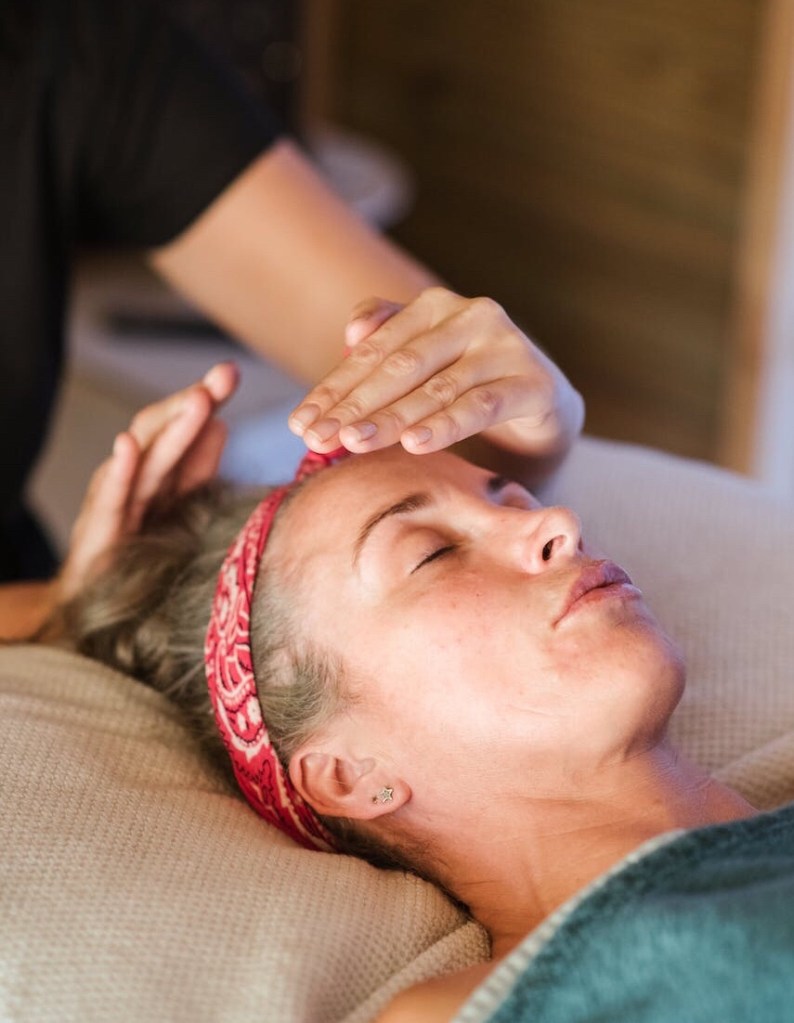
Clint receiving Reiki energy treatment

What Reiki seems to do is allow the biofield to resonate with the healing properties of the Reiki energy or ki/qi itself and to rebalance. This is called coherence. A Reiki session can bring disturbed energies in our bodies to a more harmonic state. Because our bodies strive for homeostasis, Reiki can facilitate the body’s self-healing capabilities.

According to a 2009 article National Center for Complementary and Alternative Medicine (NCCAM), “People use Reiki for relaxation, stress reduction, and symptom relief, in efforts to improve overall health and well-being. Reiki has been used by people with anxiety, chronic pain, HIV/AIDS, and other health conditions, as well as by people recovering from surgery or experiencing side effects from cancer treatments. Reiki has also been given to people who are dying (and to their families and caregivers) to help impart a sense of peace. Clients may experience a deep state of relaxation during a Reiki session. They might also feel warm, tingly, sleepy, or refreshed. Reiki appears to be generally safe, and no serious side effects have been reported.”

Researchers Susan Thrane and Susan Cohan, both at the University of Pennsylvania School of Nursing, searched forty-seven research articles to discover if Reiki had a measurable effect on pain and/or anxiety in cancer and post-surgery patients as well as seniors living in a dedicated setting. To conform to their criteria for control groups and size of study, this number was whittled down to seven studies at which they looked in depth. In all, Reiki showed evident of decreasing pain or anxiety levels over the placebo (sham Reiki) or rest alone.

Thrane and Cohan’s article, republished by The National Library of Medicine, contains excellent diagrams showing how quantum physics is being used to explain the effectiveness of Reiki and other energy modalities. They point out the similarities between device-generated electromagnetic field for wellness such as a TENs unit and human-generated biofield energy such as Reiki. They conclude that more research is needed.

Reiki is easy to integrate with massage or other modalities like Craniosacral Therapy. You can have Reiki alone and usually will be fully clothed if that is the case. It’s a great modality for someone who is a little modest about massage, and Reiki alone has many of the same benefits as massage. It’s also good for the very ill or for fibromyalgia patients for whom massage that directly manipulates the tissues would be painful or otherwise contraindicated.

Much of the early literature written about Reiki was not based on science. We are gratified that anecdotal evidence of Reki’s effectiveness is now being corroborated by controlled scientific studies in quantum physics.
, ,
, ,
Massage & Bodywork, Tapestry Life Resource

The Benefits of Craniosacral Therapy

Used with permission. Image by Salvatore Vuono at FreeDigitalPhotos.net.
Note: When last visited, Vuono’s portfolio was no longer on Free Digital Photos; however, this photo is still being classified as public domain.

Craniosacral therapy is a gentle treatment approach that works with the natural, self-correcting mechanism of the body and the craniosacral system to detect and release restrictions in mobility and enhance the function of the craniosacral system.

The craniosacral system includes the membranes and fluids that surround and protect the brain, spinal cord, and nerves. Restrictions in the rhythmical movement of the craniosacral system can cause sensory, motor or neurological dysfunction.

The techniques of Craniosacral Therapy were developed by osteopathic physician John E. Upledger, founder of the Upledger Institute. Dr. Upledger based his method on the research of Dr. William Sutherland, another osteopath, who is considered the father of craniosacral therapy.

Sutherland observed that, contrary to general belief, the bones of the skull do not fuse completely in early childhood. This means that through very gentle touch, they can be moved, and consequently, the tissues attached to them can be moved. Furthermore, early in his career, Dr. Upledger realized that the membranes surrounding the brain and spinal cord move in a rhythm, different from respiration or the heartbeat. He developed a technique to palpate and manipulate this craniosacral rhythm.

“Dr. John” taught this technique internationally and widely published his research on the efficacy of the treatment protocol. His research is continuing under the auspices of the Institute and the many students and teachers who continue to scientifically validate the usefulness of CST in treating a variety of complaints.

So what is the technique? Using pressure of about five grams, the therapist is able to palpate or feel the rhythm of the craniosacral fluid moving through the tissues of her clients and uses her evaluation of the flow and restrictions to focus treatment on the causes of dysfunction rather than only on the symptoms. She used the bones, mostly in the head and spine, to manipulate the tissues and fluid that affect the whole body.

The client lies on the heated treatment table and usually remains clothed. It may seem like not much is happening because the touch is so light and the therapist does not move around a lot. Many clients go to sleep, and that is fine. The sense of relaxation may continue for several days as the body continues to heal itself and achieve a greater state of balance. Clients often claim their pain is alleviated for longer periods and their mood is improved. The effects are subtle and tend to build with treatment.

The therapy has been used successfully to treat such disorders as headaches, neck and back pain, TMJ, fibromyalgia, motor coordination difficulties, vertigo, edema, neuropathy and nerve compression syndromes. It is also good for chronic conditions that may have an emotional component such as fibromyalgia, attention deficit disorder, anxiety and depression, and even learning problems.

Craniosacral Therapy also has a strong component that focuses on mobilization of the fascia, the continuous sheet of connective tissue that surrounds the organs, muscles, bones, nerves, vessels and other structures of the body. This three-dimensional fascia runs head to toe, front to back and exterior to interior in the body.

Release of fascial restrictions in one part of the body can affect painful tissues in other parts of the body and cause them to also release. The craniosacral system an be used as an indicator of fascial restriction, and then a gentle myofascial release technique can be used to normalize muscle tone, decrease pain, decrease swelling and increase soft tissue and joint mobility. The benefits are usually immediate. For this reason, CST is considered to be a deep tissue modality even though the client does not disrobe and even though the pressure is only 5 grams.

People of all ages, from babies to grandparents, can benefits from craniosacral therapy. In fact, unless there is a high-risk condition affecting the brain or spinal cord, like an aneurysm or tumor, most people can benefit from CST. Recent research even suggests it is helpful for people with traumatic head injury or autism. In any event, your therapist will obtain a medical history before doing a treatment and may ask you to get doctor’s approval if anything seems contraindicated.

Continuing Education, Human energy field, Massage & Bodywork

Unwinding the Meridians

I recently took a new Craniosacral Therapy class from the Upledger Institute on unwinding the meridians. We studied the rudiments of Traditional Chinese Medicine in massage school, and there was a good bit of TCM on the NC Board of Massage and Bodywork Therapy licensing exam, which I took in 2007. (Wow! Have I been doing massage that long?)

We also took Touch for Health Level 1 in massage school as the owner of the now closed Whole You School of Massage and Bodywork, Cheryl Shew, believed it was one of the best classes to prepare us for the massage exam. It is based on TCM and applied kinesiology and is an incredibly effective method for balancing meridians and toning muscles.

After I finished massage school, I took the Levels, 2, 3, and 4 Touch for Health classes, and my teachers, Larry and Arlene Green, offer refreshers and online “get together” frequently. When I began the Unwinding Meridians class, I suspected my TFH books and charts might come in handy, I was right. Much of the material I had previously learned was applicable to the new technique.

I realized I needed to brush up on things though, and it actually got me excited. The more something in the class triggered previous knowledge, the more confident I felt that this is a modality I can use.

So what is it that got me so pumped? Well first of all, I could actually feel the craniosacral rhythm/energy movement when I put my fingers on the acupuncture points. As with traditional craniosacral therapy, the touch is light and less like acupressure or Shiatsu massage.

Before I tried the work on a client, I made sure to look up the acupuncture points for a problem I know she has. I could feel the rhythm shifting and changing even more strongly, maybe because I was working on a real problem. She shared my excitement.

Using craniosacral therapy to unwind the meridians can help with the emotions as well. In Traditional Chinese Medicine, each meridian is associated with organs, emotions, seasons, colors, and a whole wealth of other correspondences. If a client has several points that need to unwind along the same meridian, you can sometime discover old trauma that is the source of chronic pain that seems to have no cause by asking questions related to the meridian correspondences. The inner physician knows and will often lead you to the truth you may be avoiding.

Unwinding the Meridians with Craniosacral Therapy is now a tool in my toolbox. I hope the more that I use it, the better I will get at help clients become pain-free and enjoy life more.

Massage & Bodywork

Marketing during a slow week

The past week has been slow in terms of new clients. Repeat business is okay, but I found myself with time on my hands. I spent the extra time on marketing myself to a new audience.

One of the beauties of CranioSacral Therapy (CST) is its effectiveness for such problems as migraines and temporo-mandibular joint (TMJ) dysfunction. So when I found myself with a day without clients, I used it to compose a letter to area dentists explaining my TMJ dysfunction protocol.

I combine CST with neuromuscular massage, Reiki/Polarity, acupressure and post-isometric relaxation techniques. The result is a very effective protocol for TMJ dysfunction, but I realized that just waiting for a client with this problem to show up is not the best way to let the community know how really effective massage and bodywork can be for this malady.

That’s what made me decide to write the letters. I used the mail merge function on MSWord, and now all I need to do is stuff the envelopes and buy the stamps. I have an article from the Upledger Institute that I’m going to send as well.

As a postscript, I also used the CST mouthwork on myself. My allergies have been bad this last week. I suppose I slept with my mouth open because I woke up one morning with my TMJ hurting. By the next day, I had a headache that was fast turning into a migraine.

I used tennis balls under the occiput to induce a stillpoint, and then did the cranial vault holds as best I could on myself. Then I went to the mouthwork. This morning I can breathe and my headache is just a memory.