
Massage & Bodywork

Mixing Modalities

I recently joined an Internet social network that asked what modalities I used in my massage and bodywork practice.

The question caught me a little off-guard. I use everything I know with every massage.

By that, I mean that every modality that I’ve learned (and The Whole You, where I attended massage school, taught us a wide range of techniques and modalities) helps me analyze and determine what tools I have for giving the best massage for the client’s

individual needs.

For example, if someone comes in complaining of lower back pain, I ask questions to determine the cause (if  known), the level and quality of the pain, the duration of the pain, when and where it hurts,  what level of pressure the client prefers, and what outcome he/she is hoping to achieve. I also observe posture and range of motion before the client ever comes to the table.

Depending on those answers, I might decide that Neuromuscular Therapy is needed to release trigger points, or I might decide that Craniosacral Therapy is more likely to release fascia and energy cysts without causing the client additional pain and discomfort. While I am working, I may  use Reiki or Polarity to balance the energy and Touch for Health techniques to test the treatment and further balance the body and emotions.

It is my experience that nothing we learn is really useless. Every time I read an article in a massage journal or get a massage myself, I learn something valuable about the way the human body responds to informed touch. I make it a point to learn and practice something new every week  so that my abilities grow and my clients benefit.

I never give the same massage twice. It’s what keeps this work exciting.
Massage & Bodywork

Giving a 4-handed massage

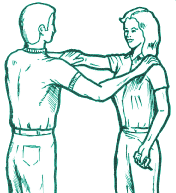
At our office at Hickory Massage Therapy, Julie and I gave a 4-handed massage today. That’s when both she and I work on a client together, so that the client gets a 60 minute massage in 30 minutes.

This client had some low back pain as a result of an old injury. After we did the client interview, we consulted with each other and decided that she would work on the upper body and I the lower body.

We had to be aware of each other’s position so we wouldn’t get in each other’s way. I found it interesting to watch how she does things a little differently from the way I do them and to actually see things that I’ve felt when she works on me.

I was also aware that with both of us working, the client wasn’t as focused on his pain. Pleasure receptors override pain receptors.

At the end of the massge, we changed positions. She worked the client’s gluteal muscles, and I worked the head and neck.

When we finished, the client said he felt much better and his pain level had dropped significantly. That is its own reward.

I look forward to our next 4-handed massage.

Massage & Bodywork

Marketing during a slow week

The past week has been slow in terms of new clients. Repeat business is okay, but I found myself with time on my hands. I spent the extra time on marketing myself to a new audience.

One of the beauties of CranioSacral Therapy (CST) is its effectiveness for such problems as migraines and temporo-mandibular joint (TMJ) dysfunction. So when I found myself with a day without clients, I used it to compose a letter to area dentists explaining my TMJ dysfunction protocol.

I combine CST with neuromuscular massage, Reiki/Polarity, acupressure and post-isometric relaxation techniques. The result is a very effective protocol for TMJ dysfunction, but I realized that just waiting for a client with this problem to show up is not the best way to let the community know how really effective massage and bodywork can be for this malady.

That’s what made me decide to write the letters. I used the mail merge function on MSWord, and now all I need to do is stuff the envelopes and buy the stamps. I have an article from the Upledger Institute that I’m going to send as well.

As a postscript, I also used the CST mouthwork on myself. My allergies have been bad this last week. I suppose I slept with my mouth open because I woke up one morning with my TMJ hurting. By the next day, I had a headache that was fast turning into a migraine.

I used tennis balls under the occiput to induce a stillpoint, and then did the cranial vault holds as best I could on myself. Then I went to the mouthwork. This morning I can breathe and my headache is just a memory.

Massage & Bodywork, Tapestry Life Resource

Touch for Health on the table

I incorporated Touch for Health into a Swedish massage today. It is the second time I’ve done so for this client. It is so easy to balance muscles with Touch for Health, and for the second time the muscle testing affirmed what I was feeling and intuiting about which muscles needed specific work.

My client is from out west and tells me that many therapists, chiropractors and alternative/complementary health providers out there use muscle testing. Not so here in the South.

I am gratified that this client called me and asked about TFH. I offered to incorporate TFH into her massage sessions free so that I could practice working with anatomical order rather than meridian order and also could practice with a client on the table rather than standing. I’m am more convinced than ever to use TFH on my clients who have chronic pain issues. I don’t use it as often as I would like because some of the tests are difficult to perform on a draped client. Getting to practice helps me to discover the best ways to keep the client comfortable while I check to muscle.

I am fortuante to have so many regular clients who don’t mind letting me try new techniques or different ways of solving their issues. I invite comments from anyone else who uses muscle testing with their clients on the table.